Adramytini olive
The Adramytini olive, one of the main and most renowned varieties of Lesvos, is a fundamental pillar of the island’s agricultural economy and gastronomic tradition, contributing decisively both to the production of virgin olive oil and as an exceptional table olive. This variety, together with the Kolovi, defines the unique character of the olive groves of Lesvos, which are considered among the oldest and largest in Greece. The tradition and know-how that accompany it have been preserved intact through the centuries, showcasing a high-quality product with distinctive organoleptic characteristics.
The Adramytini olive, also known by the synonyms Aivaliotiki or Fragkolia, is a variety with strong ties to Lesvos and the Asia Minor coast. It is one of the two dominant varieties of the olive groves of Lesvos, accounting for approximately 30% of the island’s olive trees, with the majority of its cultivation concentrated in the eastern and northeastern part.
The olive oil produced from Adramytini, often blended with the local Kolovi variety, has been recognized as a Protected Geographical Indication (PGI) product “Lesvos.” The PGI “Lesvos” certification concerns virgin olive oil derived from the Kolovi and Adramytini varieties, which are cultivated and processed within the prefecture of Lesvos. The fruit of the Adramytini, although medium in size and with a round to ovoid shape, stands out for its early ripening (November–December) and its relatively high oil content, which ranges between 20–25%. The resulting olive oil is characterized as light-bodied, particularly aromatic, with a full, refined flavor.
The cultivation of the Adramytini olive is concentrated mainly in the eastern and northeastern regions of Lesvos, in contrast to the Kolovi, which predominates in the southern and southeastern part. Its successful growth is inextricably linked to the particular soil and climatic conditions of Lesvos. The island is characterized by an immense olive grove of approximately eleven million trees, in an environment where the climatic conditions favor olive cultivation, with mild winters and dry summers.
Specifically, the Adramytiani variety thrives in rich volcanic soils (particularly in the eastern and northeastern part), although the olive tree in general is resilient and grows in all soils, even rocky ones, preferring soils with a neutral to slightly alkaline reaction (pH 7–8) and good moisture retention capacity, without, however, being waterlogged. The semi-mountainous areas with a humid climate and generous sunshine, such as the olive groves around the Alyfanta area in NE Mytilene, offer the ideal microclimate for the development and expression of the organoleptic characteristics of the Adramytiani fruit.
The cultivation of the Adramytiani olive in Lesvos largely preserves traditional practices, often on small family plots, where the care of the trees is considered a family affair. The techniques of planting, pruning, fertilization and irrigation are carried out with zeal and are based on centuries of experience, although they are enriched with modern agricultural practices. The Adramytiani olive is cultivated mainly as a dryland crop in much of the island, withstanding the harsh conditions of rocky soils.
Harvesting and Oil Extraction
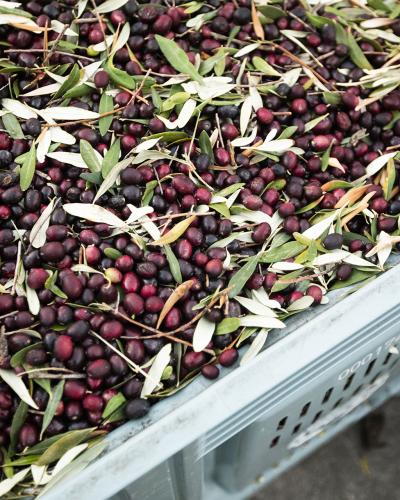
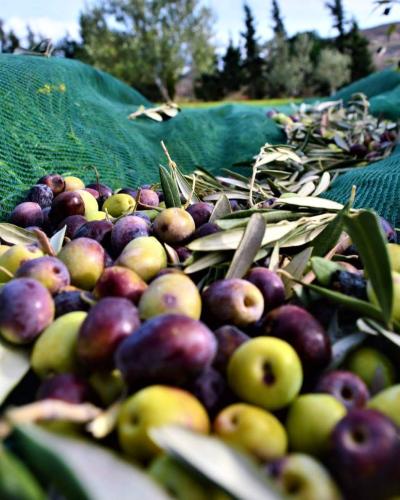
Harvesting is the most critical phase. Because the Adramytiani ripens earlier than the Kolovi, its harvest begins sooner, usually from November to December. The traditional harvesting method in Lesvos often involves collecting the fruit directly from the tree (by beating the branches or using shakers) onto nets, or gathering the fruit that has fallen naturally (although the modern trend favors direct beating for better quality). Immediate transport of the fruit to the olive mill is crucial for quality.
Oil extraction is carried out in the island’s traditional or centrifugal olive mills. In Lesvos, historically, the olive oil industry was particularly developed in the 19th century, with the famous olive presses constituting architectural and industrial monuments. Today, the process takes place in modern facilities, adhering to high standards, often with cold extraction (temperature below 27°C) to preserve the aromatic and phenolic components of the oil. The final product, either as a monovarietal Adramytiani or as a blend with Kolovi (as in PGI Lesvos), is standardized and stored under ideal conditions to preserve its quality.
The cultivation of the Adramytini olive, alongside the Kolovi, has an immense economic, social and cultural impact on Lesvos. The island’s olive grove is its largest monoculture, providing income to thousands of producer families. Historically, the production of olive oil and soap from Lesvos (using the local varieties) supplied the markets of Europe in the 19th century, leading to great economic prosperity and cultural development, with the construction of villas and industrial buildings (olive mills, soap factories) of unique architecture.
Today, the recognition of the olive oil as PGI “Lesvos” strengthens the reputation and added value of the product in international markets, promoting standardization and exports. Moreover, the extensive olive grove is a dominant feature of the Lesvos landscape and a means of preserving biodiversity, while the harvesting season (in the autumn) remains an important social and agricultural event.
The Adramytini olive takes its name from the region of Adramyttion (modern Edremit) on the opposite Asia Minor coast, from which it originates. Its presence on Lesvos is the result of centuries-old cultural and commercial relations with Asia Minor, which intensified particularly during the period of the Ottoman Empire.
Lesvos is one of the oldest olive-growing areas in the Mediterranean, with the cultivation of the olive known since antiquity. During the industrial revolution of the 19th century, Lesvos developed into one of the most important centers of olive oil and soap production, with the Adramytini (together with the Kolovi) forming the basis of this production. This economic boom profoundly influenced local society, architecture and culture, creating a wealthy urban class of olive oil producers and merchants who financed schools, the arts and public works.
The customs surrounding the Adramytini olive and olive cultivation on Lesvos are closely tied to the cycle of the year. The most important custom is the harvesting of the olives in the autumn and early winter.
- The Olive Harvest: The harvest was, and in many cases still is, a family or communal task. Neighbors, relatives and friends took part in the “liomazoma” (olive gathering), in an atmosphere of cooperation and festivity. The midday meal in the olive grove was a kind of ritual, where everyone shared simple, traditional delicacies.
- The First Oil: After the crushing of the fruit, tasting the fresh, warm olive oil (“first oil” or “agourelaio”) on toasted bread, often right at the olive mill, is a deeply rooted tradition. This moment symbolizes the crowning of the year and the blessing of the harvest.
- The Preservation of Table Olives: A traditional custom is the preservation of the Adramytiani fruit as table olives in salt (salt-cured olives) or in brine, a practice that ensured food for the entire year.
The olive oil produced from the Adramytiani and Kolovi varieties of Lesvos has received many international distinctions in quality competitions, a fact that confirms its high quality and distinctive organoleptic characteristics, which are associated with the Adramytiani (which often accounts for 80% of blends).
- Example of Distinctions (Olive oil based on Adramytiani/Kolovi):
- Competition: ATHENA International Olive Oil Competition (IOOC)
- Year: 2024 (Indicative, refers to a recent distinction)
- Organization: ATHENA IOOC
- Award: Gold Medal
- Special Prize: Best olive oil of the Aegean islands