Apples, Pears (Karvouni mountain range)
The cultivation of apples and pears in the mountainous mass of Karvounis (or Ampelos) on Samos is a longstanding agricultural activity, which falls under the broader category of tree crops. This particular production, although small-scale due to the morphology of the terrain, plays an important role in the local economy and diet, as it takes place in the semi-mountainous and mountainous parts of the island. These areas, in contrast to the lowlands that focus mainly on olive growing and citrus, offer the necessary cool and moist climatic conditions that favor the development of pome fruits, especially during the summer months. The emphasis on organic or integrated production management, practiced within small family farms, gives Samiot apples and pears particularly distinctive quality characteristics, linked to the purity and unique flavor of the mountainous environment of Karvounis.
The uniqueness of these products lies in their traditional cultivation in mountain orchards (small plots, often on terraces), using old local as well as modern varieties that thrive in the mountain’s microclimate. The lack of large lowland areas and the need for manual labor contribute to the preservation of methods that approximate organic/integrated cultivation, creating fruits with intense aromas and a high concentration of nutrients.
The cultivation of apples and pears is located in the mountainous mass of Karvounis, also known as Mount Ampelos, which is the second highest mountain of Samos, with an altitude reaching approximately 1,153 meters. The cultivated areas for pome fruits are concentrated mainly in the mountain villages of the island, where the climatic conditions are more favorable. In particular, apples and pears thrive in areas with higher humidity and lower temperatures in the summer. The geography of Samos is characterized by high biodiversity and small agricultural plots, interspersed with forested areas, often shaped into terraces (dry stone walls), a landscape especially prominent in the mountains, which necessitates the use of traditional, non‑intensive cultivation methods. These environmental conditions provide the fruit with a cool and humid microclimate during the growing period, a factor that is critical for the quality of pears and apples, which require a specific number of chilling hours in winter (around 400–800 hours below 7°C for most varieties).
The cultivation of apples and pears in Karvounis, especially in organic farms/orchards, follows traditional and environmentally friendly practices, adapted to the mountainous terrain.
Soil–Climatic Requirements and Techniques
The trees are planted in calcareous and schistose soils with low fertility but good drainage, a feature that is essential to prevent neck and root diseases such as Phytophthora, etc. Cultivation requires irrigation during the summer period, using drip irrigation systems. In organic cultivation, organic fertilizers and approved plant‑protection formulations are used (e.g. Bacillus thuringiensis). Disease management (e.g. scab) is done mainly with copper. Pruning is carried out to ensure good shaping and fruiting of the tree, while fruit thinning is done by hand, a time‑consuming and labor‑intensive process that nonetheless ensures larger and higher‑quality fruits.
Seasonality and Harvesting
Seasonality depends on the varieties, with early ones harvested as early as August (e.g. Royal Gala‑type varieties in apples) and late varieties extending into October–November. Harvesting is done exclusively by hand, ensuring the quality of the delicate fruit.
Sorting / Standardization
It focuses on sorting based on quality criteria and on preserving the fruit. The main operations include:
- Sorting/Storage/Cooling: Use of refrigeration chambers to preserve the fresh fruit.
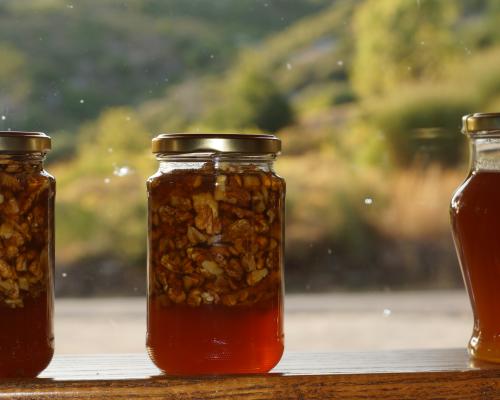
- Processing into Traditional Sweets, e.g. jams or compotes, practices widely used to utilize the production.
The traditional cultivation of apples and pears in the mountainous mass of Karvounis has a significant impact on Samos. Economically, this cultivation supplements the income from agricultural production, which is dominated by viticulture and olive growing. It also provides income to mountain villages (such as Pyrgos, Mesogeia, Pandrosso, which is located at an altitude of 650 meters on Karvounis), where usual agricultural activities are limited. Environmentally, the maintenance of orchards on terraces contributes to biodiversity, stabilizes the soil and prevents erosion in the mountains, while the adoption of organic / integrated practices ensures reduced use of chemicals and the protection of both consumers and the environment. Socially, the cultivation of pome fruits keeps the traditional agricultural economy of mountainous Samos alive and strengthens local food self-sufficiency, offering residents seasonal, quality fruits.
The cultivation of fruit trees, including apples and pears, has a long history on Samos, especially in areas with abundant water and favorable temperatures, such as the mountainous zones of Karvounis. Historically, Samos did not have large extensive/intensive crops, with the result that the cultivated plots were small, often family “gardens,” which rarely exceeded half a stremma and included a variety of fruits and vegetables. The systematic cultivation of certain fruits, such as citrus, developed earlier due to their commercial value. However, the cultivation of tobacco, fruits and vegetables in general was systematically strengthened in the mountainous areas of the northern part of the island in the late 19th century (around 1890), as a means of economic recovery for farmers who had lost their income because of the replanting of vineyards after phylloxera. Since then, the mountain apples and pears have been incorporated into the local dietary tradition and constitute a cultural element of mountain rural life.
With regard to apples and pears in Karvounis, traditions are mainly linked to the seasonality of the harvest and to manual labor. The harvest, which takes place from the beginning of autumn, is a period of family or communal cooperation in the orchards. A particular tradition is related to the preservation of the fruit: the preparation of spoon sweets from pears (as well as from quinces) is a deeply rooted custom of Samian hospitality, in which the housewife offers the visitor a spoonful of the homemade sweet as a sign of welcome.