Colocasia of Ikaria
The Colocasia of Ikaria is a distinctive and highly nutritious root vegetable, an integral part of Ikarian cuisine, which has been recognized worldwide for its contribution to the longevity of the island’s inhabitants. Although it is a tropical plant, its cultivation on Ikaria has adapted to local conditions and is closely linked to the island’s traditional agriculture and gastronomy.
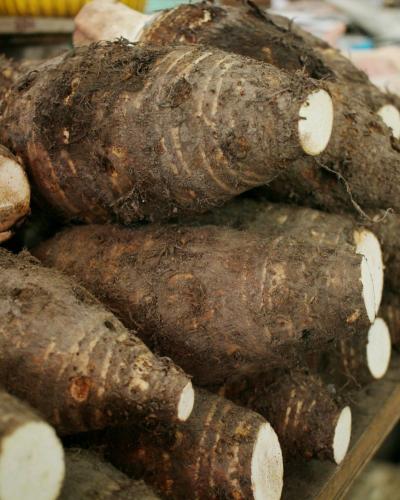
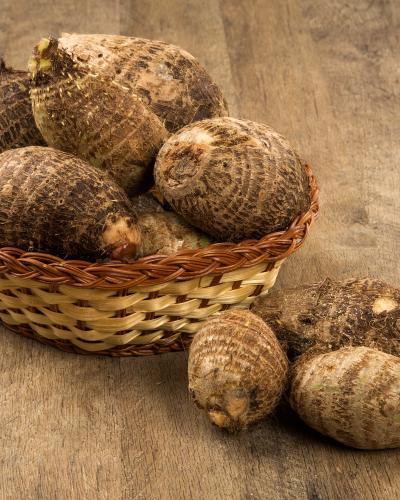
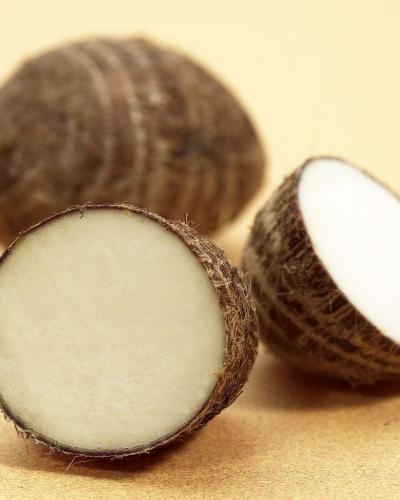
Colocasia is scientifically identified as Colocasia esculenta, a tropical plant of the Araceae family, known internationally as taro. On Ikaria it is sometimes also referred to as “Jerusalem artichoke,” although it has no botanical relation to that plant, perhaps indicating its use as a root vegetable in cooking. The plant is grown mainly for its edible corms or tuberous bulbs, which are rich in starch.
The cultivation of colocasia in Greece is limited and found mainly in two areas: Cyprus (where it is particularly widespread) and Ikaria. Ikaria, as an island of the North Aegean, has local microclimates that allow for the cultivation of this tropical root vegetable. Specifically, colocasia requires high humidity and temperature conditions, as well as significant amounts of irrigation, which determines the cultivation areas on the island to locations where sufficient water is available, such as valleys or near streambeds. Its presence on Ikaria is indicative of the island’s distinctive agricultural tradition, which makes use of varieties of tropical origin adapted to its Mediterranean environment.
The cultivation of colocasia, as a tropical plant, has particular requirements. Planting usually takes place from late February to May, using sections of the corm. The plant develops slowly and requires irrigation throughout the growing season due to its high water needs, approximating the conditions of its natural wetland habitats of origin (possibly Malaysia/India). On Ikaria, it is traditionally cultivated on small plots, often in organic farms or gardens that rely on traditional practices and Mediterranean-style agriculture, which forms part of the inhabitants’ “longevity secret.”
The harvest of the corm takes place when the plant is fully mature. The traditional method requires special handling after harvest. The tuber must not be washed with water before processing and cooking, because it releases a slimy liquid and sticks/melts during baking. Instead, it is carefully cleaned on the outside with paper or a dry towel and then peeled with a knife. Cutting is done in a specific way: the knife is inserted into the flesh and twisted so that the tuber “breaks” into irregular pieces, rather than being cut with a normal slicing motion. This traditional technique helps to avoid sliminess and achieve a better texture during cooking. Processing is usually limited to consumption fresh or in savory dishes, although it can be dried and milled to produce edible flour.
Colocasia has a significant, though not economically dominant, impact on Ikaria, serving as a dietary pillar of the local economy of self-sufficiency and of health. Its cultivation contributes to the preservation of the island’s agricultural tradition and crop diversity. Historically, its presence has been decisive, as during difficult periods such as World War II, the colocasia corms, thanks to their abundance and their capacity to ensure food, helped the inhabitants of Ikaria avoid severe deprivation. Today, colocasia is promoted as an integral part of Ikaria’s gastronomic tourism, linking local production with the global fame of the “Blue Zone” and its secret of longevity.
Colocasia esculenta is considered one of the first plants cultivated in human history, with its homeland likely located in the wetlands of Malaysia and India. Its presence on Ikaria, together with Cyprus, Egypt, and Syria, attests to its ancient and widespread diffusion in the Mediterranean basin. On Ikaria, its cultivation has been part of the island’s food chain for many years, indicating the inhabitants’ ability to adopt and adapt crops that ensured their food security. Its historical significance is underscored by the fact that its corms constituted a staple survival food during the Occupation, reinforcing its image as a “traditional survival food” in the local consciousness.
Colocasia is an integral element of Ikarian cuisine, embodying agricultural self-sufficiency and respect for the fruits of the earth—features central to the island’s way of life. Its presence, both at traditional festivals and at family tables, is in itself a cultural tradition. Furthermore, its preparation, which includes a distinctive method of cleaning and cutting (a traditional technique), is passed down from generation to generation, preserving the authenticity of the dish.
Ikaria Colocasia is considered a superfood and one of the key factors contributing to the longevity of the Ikarians, as it fits harmoniously into the pattern of their healthy, Mediterranean-type diet. It is an extremely nutritious food, rich mainly in starch, while at the same time having a relatively low glycemic index, which makes it beneficial for the prevention of diabetes.
Nutritional Analysis (per 100 g of edible portion, indicative values)
- Macronutrients: It is rich in carbohydrates (starch), contains proteins and has a high dietary fiber content (about 6% of the recommended daily intake). These fibers, including inulin (a prebiotic fiber), are associated with good intestinal health, combating constipation and reducing cholesterol.
- Vitamins & Minerals: It is a good source of vitamins and minerals, with significant levels of vitamin C (antioxidant), B-complex vitamins (e.g. B1/Thiamine, B6), phosphorus and potassium. Particularly important is its contribution as a very good source of plant-based iron (it can cover up to 20% of the recommended daily intake per 100 grams).
- Bioactive Compounds: The tubers contain antioxidant substances and amino acids and are credited with anticancer and antidiabetic properties.
- Toxicity Note: It is critical to point out that raw colocasia (corms and leaves) is toxic due to its high content of calcium oxalate. This toxin is completely neutralized by proper cooking, making it safe for consumption after thermal processing.
Ikaria Colocasia is considered a superfood and one of the key factors contributing to the longevity of the Ikarians, as it fits harmoniously into the pattern of their healthy, Mediterranean-type diet. It is an extremely nutritious food, rich mainly in starch, while at the same time having a relatively low glycemic index, which makes it beneficial for the prevention of diabetes.
Nutritional Analysis (per 100 g of edible portion, indicative values)
- Macronutrients: It is rich in carbohydrates (starch), contains proteins and has a high dietary fiber content (about 6% of the recommended daily intake). These fibers, including inulin (a prebiotic fiber), are associated with good intestinal health, combating constipation and reducing cholesterol.
- Vitamins & Minerals: It is a good source of vitamins and minerals, with significant levels of vitamin C (antioxidant), B-complex vitamins (e.g. B1/Thiamine, B6), phosphorus and potassium. Particularly important is its contribution as a very good source of plant-based iron (it can cover up to 20% of the recommended daily intake per 100 grams).
- Bioactive Compounds: The tubers contain antioxidant substances and amino acids and are credited with anticancer and antidiabetic properties.
- Toxicity Note: It is critical to point out that raw colocasia (corms and leaves) is toxic due to its high content of calcium oxalate. This toxin is completely neutralized by proper cooking, making it safe for consumption after thermal processing.