Prickly pear
The cultivation and consumption of prickly pears (Opuntia ficus-indica) in Ikaria is part of the island’s broader tradition of utilizing dry, hot and poor soils, contributing to a diet rich in dietary fiber and vitamins. The prickly pear, as the fruit of a succulent cactus, is extremely resistant to drought and high temperatures, making it an ideal crop for Mediterranean islands such as Ikaria, where rainfall is often limited.
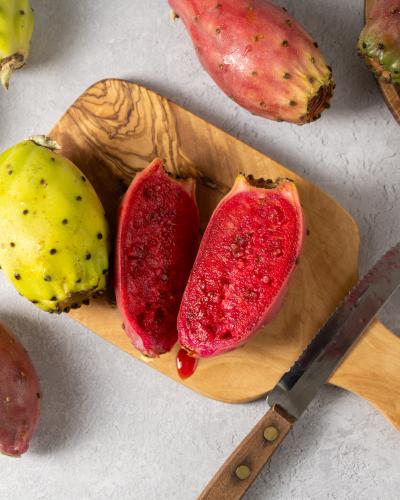
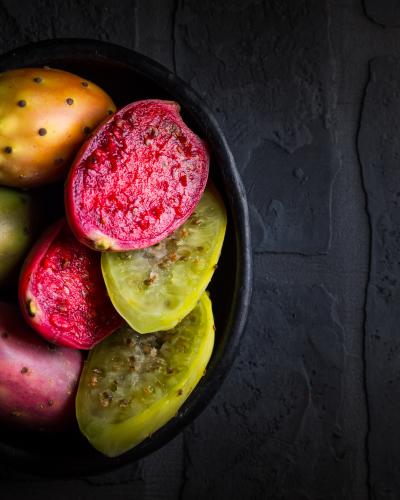
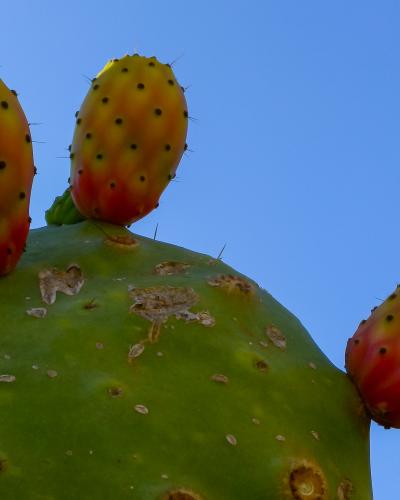
The product concerns the fruits of the prickly pear plant (Opuntia ficus-indica), which belongs to the cactus family (Cactaceae). In Greece, it is also known by the names Pavlosyko or Indian fig. It is an ovoid or cylindrical fruit, approximately 5–10 cm in length and 80–200 g in weight, with excellent, aromatic flesh and a multitude of hard seeds.
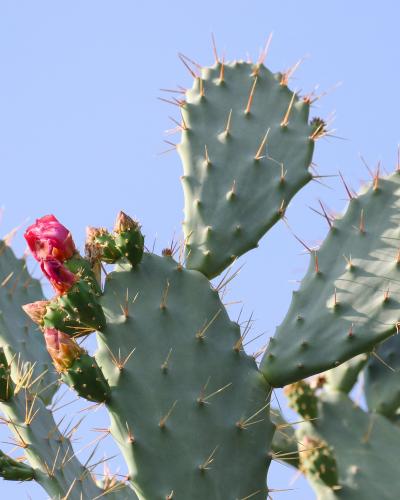
The cultivation of prickly pear in Ikaria takes place mainly in rocky, dry and arid soils, which are poor in organic matter and nutrients but have good drainage. These soils, which are often considered unsuitable for other crops, are well suited to the prickly pear due to its particular physiology, which allows it to store water in its tissues and reduce transpiration. Ikaria’s climate, which is dry–thermal and Mediterranean, with long periods of sunshine, is ideal for the development of the prickly pear. The plant’s resistance to conditions of water stress (drought) is perfectly in line with the need of the inhabitants of Ikaria to make use of every inch of land with the least possible consumption of water resources.
The cultivation of prickly pear in Ikaria, as in many Mediterranean regions, follows traditional and low-intensity methods that are particularly environmentally friendly, in harmony with the philosophy of organic farms.
Planting and Care
The reproduction of the plant is extremely easy and is traditionally done by cuttings (the so‑called “pads” or “leaves”), which are sections of the stem. The cutting is taken from the mother plant and left to heal for about 4–7 days before planting, in order to avoid fungal infections. Then it is planted vertically in the soil, to about one third of its length. Prickly pear does not require irrigation after establishment, apart from perhaps some initial watering to promote faster rooting, and its survival relies on the accumulation of water in its succulent stems. Plantings are made at wide spacings, usually at distances of 5 x 5 meters, allowing unobstructed growth.
Cultivation Practices
The main cultivation practices include pruning, which is necessary for shaping the plant, removing misshapen or damaged stems, and facilitating aeration and harvesting. Pruning is usually carried out in spring or late summer. If fertilization is deemed necessary, organic fertilization is preferred and focuses mainly on phosphorus and potassium, avoiding chemical fertilizers, especially on organic farms. Often, the first flowers or immature fruits are also removed to improve the quality and size of the final fruits (re‑blooming or “scozzolatura,” a practice that enhances the second, higher‑quality fruiting).
Harvesting and Processing
Fruit harvesting takes place mainly in the summer months (July–September). The process is particularly laborious due to the spines (glochids) of the fruit, tiny bristles that cause irritation. Traditionally, harvesting is done using long tools (e.g., a pole with a tin can or container fixed to the end) to detach the fruit. After harvest, the removal of the spines is critical and often involves practices such as rubbing the fruits in sacks or washing them with water, so they can be marketed as “spineless.” In Ikaria, the processing of prickly pears includes consumption as a fresh fruit, as well as the preparation of jams, spoon sweets, liqueurs, juices, and other products, fully leveraging their nutritional value.
The prickly pear cactus in Ikaria has a significant environmental and economic impact, beyond its dietary role. Environmentally, as a plant that thrives in dry conditions and poor soils, it contributes to soil improvement and erosion control in areas with steep slopes. Its cultivation fits ideally within the framework of organic and sustainable agriculture, as it requires almost no water or chemical fertilizers/pesticides. Economically, the prickly pear cactus offers an alternative source of income to the farmers of Ikaria, especially through the processing of its fruit into high value-added products (liqueurs, jams, juices) and its connection with the branding of Ikaria as a “Blue Zone” and a tourist destination with an emphasis on healthy nutrition.
The prickly pear cactus (Opuntia ficus-indica) originates from Mexico and was brought to Europe by the Spanish conquerors in the 16th century (around 1521–1523). Its rapid spread in Mediterranean countries is due to its ability to adapt to dry climates and its sweet fruits. In Ikaria, the prickly pear cactus has always been an important supplement to the residents’ diet, especially during periods of severe drought or lack of other fruits. Traditionally, it was not treated as a systematic crop, but as a wild, resilient plant that marked property boundaries and offered food without effort.
In Ikaria, as in other islands, the harvesting and peeling of prickly pears constituted a special summer ritual. The knowledge of the safe way to gather them (using poles and buckets) and to remove the spines (by rubbing or with water) was passed down from generation to generation, forming a hallmark of local folk wisdom. Moreover, due to its high water and nutrient content, the fruit was often traditionally associated with relief from thirst and hydration during the hot summer months.