Salted fish
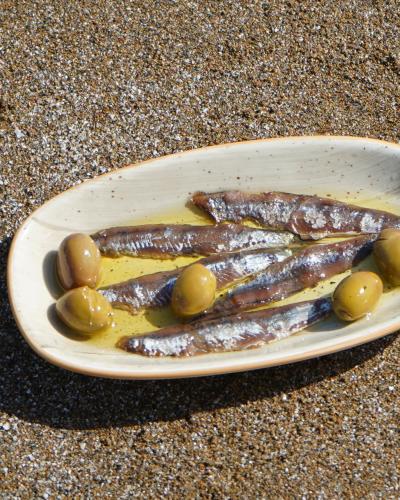
Salted fish products are one of the most important gastronomic identities of Lesvos, with the island’s tradition in fish preservation disappearing into the depths of the centuries. Lesvos, due to its geographical position in the Northeastern Aegean and its proximity to seas rich in fish, developed exceptional know-how in the fishing and salting (curing) primarily of small pelagic fish. The production of salted fish on the island is not merely a method of preservation, but an art of maturation that transforms fresh fish into a select delicacy. The principal salted fish products of Lesvos are the Kalloni Sardine (from the Gulf of Kalloni) and Mackerel, which are traditionally served as the quintessential meze for ouzo, combining the island’s two top gastronomic identities.
The uniqueness of Lesvos salted fish products lies in the local raw material, the particular fishing conditions, and the traditional maturation technique.
- Identification, Synonyms, Variations: The main species that are fished and processed in Lesvos are:
- Salted Sardine (Kalloni Sardine): Sardina pilchardus.
- Salted Mackerel: Scomber colias or Scomber scombrus.
- Salted Anchovy: Engraulis encrasicolus.
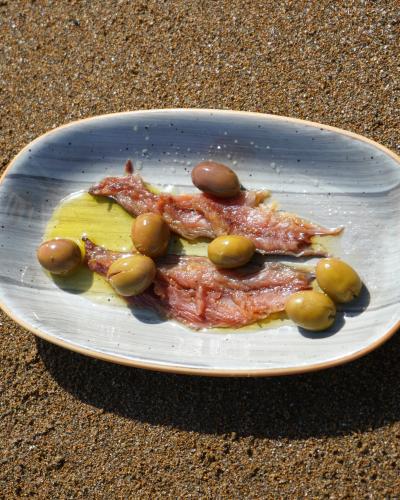
- Basic Specifications (Kalloni Sardine): The fish must be caught exclusively in the Gulf of Kalloni. The maturation process must be carried out with salt for a specific period (usually 1–2 months) under controlled conditions. The final product retains the rose-like or pink color of its flesh, which is a hallmark of high quality.
The geographical area of Lesvos is critical, as the Kalloni Sardine takes its name from the Gulf of Kalloni, an enclosed gulf with distinctive characteristics.
The Gulf of Kalloni forms a closed ecosystem with low salinity and stable, relatively warm waters compared to the open Aegean. These conditions, combined with the rich food (plankton) present in the gulf, lead to the creation of a smaller-sized but fattier and tastier fish (sardine), ideal for curing. The processing takes place in traditional workshops located mainly around the gulf (e.g. Skala Kallonis) and in Petra.
The production of salted fish in Lesvos follows a strictly defined chain from fishing to final maturation.
- Fishing Method (Seasonality): Kalloni Sardines are caught mainly during the summer months (June - August), when the sardine is at its peak fat content (it has “harvested” the plankton) and is ideal for salting. Fishing is carried out with purse seines or mechanical trawlers, in accordance with fishing regulations.
- Processing & Salting: The procedure must begin immediately after the catch (within a few hours).
- Cleaning: The fish are not gutted (or are only partially cleaned), as the intestinal enzymes play a decisive role in maturation and flavor.
- Salting: They are placed in wooden barrels or special containers in layers, alternating with coarse salt (usually from the salt pans of Kalloni or Limnos, reinforcing the local character).
- Maturation: The fish remain under pressure (with weights) for a period of 40 days to 2 months, at controlled low temperatures. During maturation, the salt dehydrates the fish and its proteins are broken down by enzymes, giving the characteristic umami flavor and soft texture.
- Standardization: The salted fish are sold either in barrels (in bulk) or in glass jars (standardized), often preserved in Lesvos olive oil, enhancing synergy with the island’s other flagship product.
The production of salted fish in Lesvos is a strategic pillar of the island’s local economy and identity.
- Economic Importance: The fishing and processing of Kalloni Sardine support a significant part of the primary and secondary sector in the gulf area, providing jobs in fishing, processing, and packaging.
- Touristic Promotion: Salted fish, as the quintessential ouzo meze, are a magnet for gastronomic tourism, directly linking local production with the experience of the Lesvian taverna and traditional restaurants.
The tradition of fish salting in Lesvos dates back at least to the Byzantine era, but it experienced its greatest flourishing in more recent centuries.
The need to preserve the large quantities of fish that were caught, especially after the development of commercial fishing, led to the systematic production of salted fish. The art of salting was passed down from generation to generation, with the families of fishermen and processors developing secret recipes for the correct ratio of salt, the pressure, and the maturation time, which determine the final taste.
Salt-cured foods, and especially salted sardines, are inextricably linked with the social life and customs of the island.
- The Ouzo Meze: The consumption of salt-cured foods is the ritual that accompanies Lesvos ouzo (the island’s other PGI product). Tradition dictates that ouzo be consumed with small, salty bites, and salt-cured foods are the ideal choice.
- Sardine Festival: Every summer, in Skala Kalloni, the Sardine Festival is held, a large local event that includes grilling thousands of sardines, music and dancing, in honor of this key product of the gulf.
Kalloni Sardine and other salt-cured products of Lesvos have received distinctions both for their unique flavor and for the quality of their processing.
- Competition: Great Taste Awards (International)
- Category: Delicatessen / Preserved Seafood
- Level: 1–3 Stars
- Competition: Taste Selection (Greece)
- Category: Traditional Products / Salt-Cured Foods
- Level: Gold/Silver Award