Decoctions (kisthnos, other xeric shrubs)
Lesvos possesses a rich and unique flora, thanks to its diverse geological substratum and its Mediterranean climate. In the category of Aromatic Plants and Herbs, Rockrose (Cistus) and other drought-tolerant shrubs hold a prominent place, not only as wild vegetation but also as collected and processed products for the preparation of herbal infusions. Rockrose, particularly the species Cistus creticus (Cretan rockrose) and Cistus incanus (hairy rockrose), is one of the most widespread and historically significant plants of Greek flora. In Lesvos, Rockrose thrives in dry and rocky areas, often together with other aromatic plants such as Thyme (Thymus), Oregano (Origanum) and Jerusalem Sage (Phlomis), creating a rich variety of herbs that are collected for the production of aromatic and medicinal infusions.
The uniqueness of Rockrose and drought-tolerant shrub infusions from Lesvos is based on the increased concentration of bioactive compounds, due to the dry, warm environment and the rich soil substrate.
- Identification, Synonyms, Variants: The main product is Rockrose (Cistus creticus / Cistus incanus). Common synonyms are “Kounoukla” or “Ladania” (from the resinous exudate labdanum). Other drought-tolerant shrubs used for infusions in Lesvos are: Sage (Salvia fruticosa), Thyme (Thymus capitatus) and certain Heather species (Erica).
- Several units on the island produce herbs with Organic Farming Certification (EU standards), particularly for Rockrose and Oregano, ensuring their quality and purity.
- Basic Specifications: The quality of the product depends on: a) The method of collection (sustainable), b) The season of collection (the period of maximum concentration of essential oils and polyphenols, usually spring/early summer for Rockrose), and c) The method of drying (natural drying in the shade with proper ventilation).
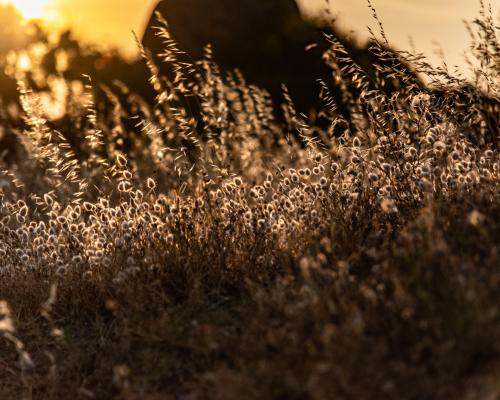
Rockrose and drought-tolerant shrubs thrive throughout Lesvos, especially in areas with phrygana-type vegetation and low humidity, typical of the Mediterranean ecosystem.
Extensive stands of rockrose mainly cover the semi-mountainous and dry areas of the island, such as certain locations around the Gulf of Kalloni and the western parts, where volcanic soils predominate. These soils are often stony, poor in organic matter and well-drained—conditions ideal for rockrose. The particular climate of Lesvos, with a long dry season and intense sunshine, drives the plants to produce higher concentrations of resins (such as rockrose labdanum) and essential oils as a defense mechanism against dehydration and UV radiation. This natural adaptation translates into products with a more intense aroma and greater medicinal value.
The production of herbal infusions from rockrose and dry-farmed shrubs of Lesvos is based mainly on controlled wild harvesting and, secondarily, on organized organic cultivation.
- Harvesting Method (Wild Rockrose): Harvesting is done by hand, usually during the period of peak flowering (May–June) or slightly earlier, when the concentration of bioactive compounds is highest. Harvesting is carried out in a sustainable manner, cutting only the tender parts of the plant (leaves and flowers) and never the entire plant, thereby ensuring regeneration.
- Cultivation (Organic): Certain operations on Lesvos have turned to organized organic cultivation of rockrose and other herbs in order to ensure consistent quantity and quality. This cultivation is dry-farmed (rarely or not irrigated at all), reflecting natural conditions, and exclusively natural fertilizers and mechanical weed control are used.
- Drying: This is the most critical stage. Immediately after harvesting, the plants are spread out in thin layers in shaded, well-ventilated areas (e.g., special dryers or sheds) at a temperature not exceeding 40 °C. Fast and gentle drying is essential for preserving the plant’s polyphenols and volatile essential oils, which are sensitive to heat and light.
- By-products:
- Labdanum: Labdanum, the aromatic resin exuded by rockrose, is an important by-product. Historically, it was collected with the ergastiri (a special tool), and today it is used in perfumery and pharmaceuticals.
- Essential Oils: Essential oils are produced from rockrose, oregano or thyme through the process of hydrodistillation.
The collection and processing of Cistus and other herbs contributes to the development of organic farming and to the protection of the biodiversity of Lesvos.
The creation of small herb-processing enterprises offers alternative sources of income to farmers, especially in mountainous and semi-mountainous areas where olive cultivation is not as profitable. The use of local and indigenous plants supports the preservation of the cultural landscape and the genetic heritage of the island. Finally, the connection of herbs with honey production (Cistus is a melliferous plant) and perfumery strengthens synergies between agricultural sectors.
Cistus, especially as a source of labdanum (an aromatic resin), has a centuries-long history in Lesvos and the Eastern Mediterranean, being mentioned since antiquity for its aromatic and medicinal properties.
Labdanum was a valuable trade product in antiquity and was used in religious ceremonies, perfuming and medical prescriptions. The collection of labdanum, traditionally through goats and sheep that grazed on the shrubs and were then shorn, or with the special tool “ergastiri” (a method that has now been abandoned), constitutes an important part of the island’s agrarian and ritual history.
Herbal infusions are an integral part of the traditional medicine and diet of Lesvos.
- Nature’s “Gift”: The inhabitants of the island traditionally knew and used Rockrose, Sage, and Thyme as ecological remedies for colds, gastrointestinal disorders, and as tonics. The custom of hand-picking and storing dried herbs for the winter is maintained in many homes in Lesvos, where they are regarded as a gift from nature.
- The Ritual of the Infusion: The preparation of the infusion, especially using boiling water rather than boiling the herbs directly (so they do not lose their essential oils), is a small ritual that is passed down from the grandmother to the younger generation.
Rockrose products and other herbs from Lesvos have received distinctions, mainly in competitions for taste, quality, and organic products.
- Competition: Great Taste Awards (international competition)
- Category: Organic infusion (e.g., dried Rockrose)
- Level: 1–3 Stars
- Competition: National Organic Products Competition
- Category: Herbs and Dried Plants
Rockrose and dry-farmed shrubs are extremely important for their bioactive compounds.
- Macronutrients: The infusions provide zero energy, proteins, fats or carbohydrates.
- Bioactive Compounds: Cistus is known as one of the richest plant organisms in polyphenols.
- Polyphenols: It contains high concentrations of flavonoids and proanthocyanidins (PACs). Studies have shown that Cistus decoction (Cistus creticus) has exceptionally high antioxidant activity, far greater than green tea.
- Essential Oils: Labdanum contains terpenes and terpenoids.
- Therapeutic Use (Claims): Traditionally, Cistus is used to support the immune system and to address colds, while its polyphenols have been studied for their potential antiviral and antimicrobial properties (Sources: University studies in Greece and abroad, although more clinical trials are required).
Rockrose and dry-farmed shrubs are extremely important for their bioactive compounds.
- Macronutrients: The infusions provide zero energy, proteins, fats or carbohydrates.
- Bioactive Compounds: Cistus is known as one of the richest plant organisms in polyphenols.
- Polyphenols: It contains high concentrations of flavonoids and proanthocyanidins (PACs). Studies have shown that Cistus decoction (Cistus creticus) has exceptionally high antioxidant activity, far greater than green tea.
- Essential Oils: Labdanum contains terpenes and terpenoids.
- Therapeutic Use (Claims): Traditionally, Cistus is used to support the immune system and to address colds, while its polyphenols have been studied for their potential antiviral and antimicrobial properties (Sources: University studies in Greece and abroad, although more clinical trials are required).