Olive-oil soap
Olive-oil soap is one of the oldest and most characteristic processed products of Lesvos, with its tradition dating back at least to antiquity, according to local lore. Lesvos, as one of the largest olive groves in Greece and the Eastern Mediterranean, has always possessed the main raw material – olive oil or, more often, olive pomace oil and the by-products of olive processing – in abundance. Soapmaking initially developed as a household craft, before evolving into the island’s first industrial sector and a significant export trade during the 19th century, decisively influencing the economic and social life of Lesvos.
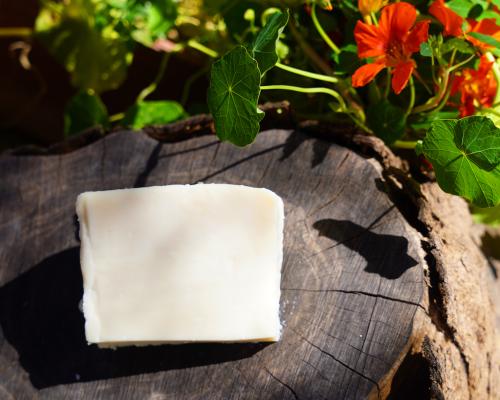
Olive-oil soap from Lesvos, traditionally known as green soap or mallasopouno, is directly linked to the island’s historical industrial heritage and to the use of Lesvian olive oil (or its by-products), which is produced to a large extent from the local Kolovi variety (also known as Megalonisi or Mytilinia), yielding high-quality oil.
The production of olive-oil soap is historically associated with those areas of Lesvos that had developed olive cultivation and processing, as well as access to ports for the import of caustic soda and the export of the final product. The main centers of industrial soapmaking in the late 19th and early 20th century were Plomari, Mytilene, Perama of Gera and Polichnitos, areas that possessed steam-powered factories (soapworks and olive mills).
The climate of Lesvos is characterized by mild, rainy winters and warm, dry summers, with the olive tree thriving in the island’s volcanic, nutrient-rich soils. The increased humidity in certain coastal areas, as well as the abundance of water (e.g. the Sedountas river in Plomari), were factors that favored the operation of industrial soapmaking units, since water was essential both in the production process (boiling, dissolution of alkalis) and in cooling the machinery.
The production of traditional olive-oil soap on Lesvos was based on the process of saponification, in which fat (olive oil or olive pomace oil) reacts with an alkaline solution (usually caustic soda, NaOH, or potash, KOH) to create soap and glycerin. Historically, either the hot or the cold method was used, while in the industrial period the former prevailed.
- Raw material: Mainly olive-pomace oil (oil extracted from the pulp/dregs, the “mourgá”) or low-quality virgin olive oil, since the high-quality oil was intended for consumption and export. The use of pomace oil (a product of secondary processing of the olive pressing) made it possible to manage the olive mill’s products in an integrated way, increasing profitability.
- Alkalis: In household production they used lye (ash from wood, rich in potassium carbonate), while in industry caustic soda (NaOH) or potash (KOH) was imported.
- Traditional Method (Hot Process):
- Boiling: The oils (pomace oil, olive oil) were mixed in large cauldrons with the caustic soda solution and water. The mixture was boiled for many hours, with continuous stirring, so that saponification could be completed.
- Salting Out (Separation): Salt (common or sea salt) was added in order to separate the soap (to “salt it out” so it would rise to the surface) from the remaining liquid phase, which contained the glycerin and alkaline salts. This process was crucial for producing a hard, long‑lasting soap.
- Drying/Curing: After being poured into large wooden molds to cool and harden, the soap was cut into pieces and transferred to the drying rooms (usually the upper floors of industrial buildings, as in Plomari) so it could cure and lose its moisture. Curing lasted several weeks or months.
- Tools: Industrial soap factories used steam engines (steam‑powered olive mills and soapworks), large copper or iron cauldrons and casting molds, while in household workshops clay vessels and wooden spoons for stirring predominated.
Industrial soap-making was one of the main pillars of the economy of Lesvos during the 19th and early 20th centuries, directly linked to the monoculture of the olive tree.
- Economic Development: Lesvos developed into a center of industrial olive soap production in the Aegean as early as the late 19th century. Production was so significant (reaching 11,000 tons of soap annually during the peak period, approximately 1875–1895) that it supplied its products to a vast market that included Constantinople, the Asia Minor coast, the Black Sea region (Odessa, Varna), and the Black Sea.
- Social Structure: The development of trade and industry created a new urban class (entrepreneurs, merchants, soap-makers) with connections throughout the Ottoman Empire and Europe (know-how from Marseille). This class played a decisive role in the cultural and social life of the island.
- Industrial Heritage: Lesvos preserves important industrial monuments, such as the stone-built soap factories and olive mills (e.g. the Poulia soap factory in Plomari, which today operates as a Soap-Making Museum and Cultural Center), which bear witness to the era of prosperity and serve as a focal point of cultural interest.
The history of soap-making in Lesvos is linked both to ancient tradition and to the modern industrial revolution of the region.
- Ancient Tradition: Local tradition holds that Lesbos is the place where soap was first discovered. Myths mention that near the altars of the goddess Artemis, animal fats mixed with wood ash and rainwater, forming a liquid that women noticed cleaned clothes better. Another myth links the accidental discovery of the cleansing substance to the Lesbian poet Sappho on a sea voyage.
- Industrial Spring: During the 19th century, Lesbos, under Ottoman administration, became a center of industrial production. Lesvian merchants, taking advantage of the abundance of olive oil and their trade networks in the East, modernized production by introducing steam-powered units and techniques from Europe (mainly from Marseilles).
- Decline: The golden age (1875–1895) was followed by a decrease in production, especially after the liberation of 1912 and the loss of the major markets of the Ottoman Empire in 1922 (Asia Minor Catastrophe), as well as due to competition from cheaper industrial soaps. Nevertheless, production on a smaller scale continued, preserving the tradition.
Soap-making is part of the tradition of household economy and cleanliness. Home soap production (usually after the end of the olive-harvesting season) was a common practice in the rural areas of Lesbos, allowing for the use of surplus oil or olive lees and ensuring a basic commodity for the whole year. It was a process that often took place in open spaces or large courtyards, bringing together the women of the household or the neighborhood. Green olive oil soap, apart from personal hygiene (body and hair), was traditionally also used as a natural detergent for washing clothes (especially delicate fabrics) and for household cleaning.
The value of olive oil soap is dermatological and cosmetic, as well as ecological, due to its natural composition.
- Bioactive Compounds (From Olive Oil):
- Vitamin E (Tocopherols): Olive oil is rich in vitamin E, a powerful antioxidant. Although part of the E is lost in hot process saponification, the cold method or superfatting (adding extra oil) preserves higher levels. E helps protect the skin from oxidation and aging.
- Provitamin A (Carotenoids): It provides moisturizing and regenerating properties for the skin.
- Polyphenols: Olive oil, especially virgin olive oil, contains polyphenols (e.g. hydroxytyrosol), which have anti-inflammatory properties.
- Glycerin: The natural saponification process (especially cold process) produces glycerin as a by-product, which remains in the soap. Glycerin is a powerful humectant that draws moisture to the skin, providing hydration and softness.
- Ingredient Analysis (Soap):
- Basic Ingredients: Soap (sodium or potassium salts of fatty acids – mainly oleic acid, C18), Water, Glycerin, NaOH (very small or negligible traces, as it has fully reacted).
- pH: Traditional olive oil soaps usually have a slightly alkaline pH (around 9–10).
The value of olive oil soap is dermatological and cosmetic, as well as ecological, due to its natural composition.
- Bioactive Compounds (From Olive Oil):
- Vitamin E (Tocopherols): Olive oil is rich in vitamin E, a powerful antioxidant. Although part of the E is lost in hot process saponification, the cold method or superfatting (adding extra oil) preserves higher levels. E helps protect the skin from oxidation and aging.
- Provitamin A (Carotenoids): It provides moisturizing and regenerating properties for the skin.
- Polyphenols: Olive oil, especially virgin olive oil, contains polyphenols (e.g. hydroxytyrosol), which have anti-inflammatory properties.
- Glycerin: The natural saponification process (especially cold process) produces glycerin as a by-product, which remains in the soap. Glycerin is a powerful humectant that draws moisture to the skin, providing hydration and softness.
- Ingredient Analysis (Soap):
- Basic Ingredients: Soap (sodium or potassium salts of fatty acids – mainly oleic acid, C18), Water, Glycerin, NaOH (very small or negligible traces, as it has fully reacted).
- pH: Traditional olive oil soaps usually have a slightly alkaline pH (around 9–10).