prickly pear
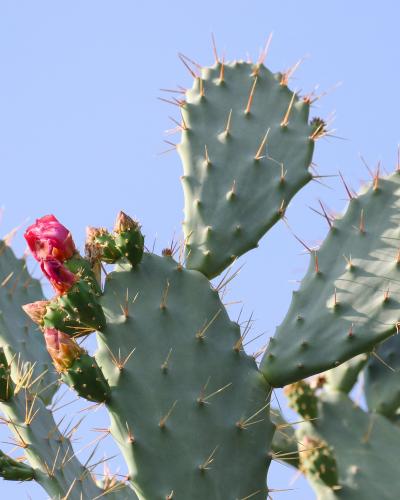
The prickly pear is the edible fruit of the cactus Opuntia ficus-indica, a xerophytic species that has adapted exceptionally well to the dry, warm climate of the Greek islands, including Fournoi Korseon in the North Aegean. In Fournoi, as in the islands of the Cyclades and the Dodecanese, the prickly pear cactus has now become a key feature of the Mediterranean landscape, with its fruits being particularly popular in summer, offering refreshment and high nutritional value.
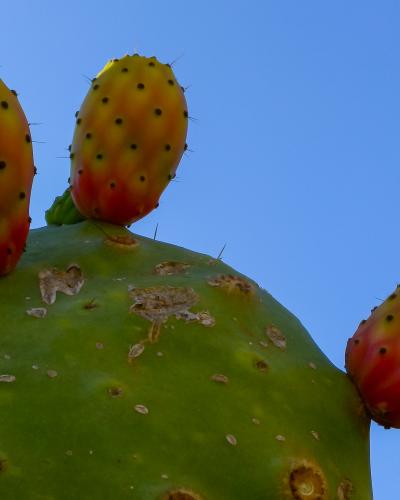
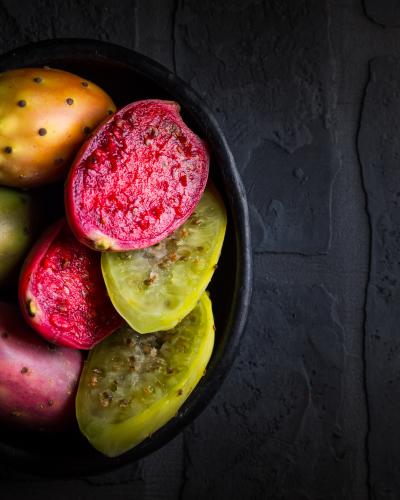
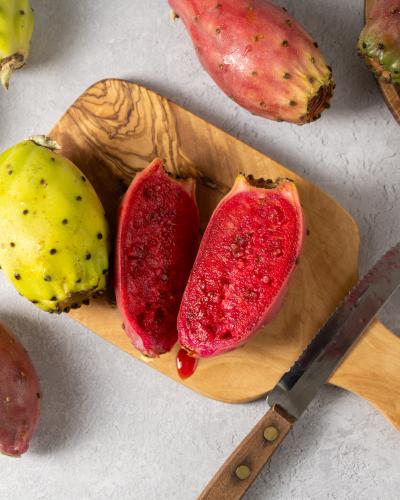
The prickly pear, known scientifically as Opuntia ficus-indica, bears various synonyms in Greece, such as “papoutsosiko” or “Indian fig”. It is an oval, fleshy fruit with a sweet taste, whose color ranges from yellow and green to reddish, depending on the variety and degree of ripeness. In Greece, various types are cultivated, though not always systematically, with the most widespread being the yellow (Sulfarina), the white (Muscaredda) and the red (Sanguigna).
The uniqueness of the fruit that develops in Fournoi lies mainly in the particular soil and climatic conditions of the island complex, which favor the development of a xerophytic species with an increased concentration of nutrients, as is generally the case with products that thrive in barren soils and dry, warm climates of the Aegean.
The soils in Fournoi are often shallow, rocky, sandy and poor in organic matter, which makes the prickly pear cactus one of the most suitable species for the utilization of problematic soils, while at the same time its strong root system helps protect against the erosion of sloping lands, a frequent phenomenon on the islands of the Aegean.
The cultivation of prickly pear in Fournoi follows xerophytic farming practices, with minimal requirements for care, water, and cost, making it ideal for the arid climate. Propagation is carried out traditionally and easily with cuttings (pads – “shoes”) that are planted directly in the ground. The plant requires warm, sunny areas and well-drained soils. Cultivation tasks are limited and include basic fertilization and formative pruning. Harvesting of the edible fruits takes place in the summer months and demands particular care and the use of special tools due to the fine spines. In Fournoi, the main use is fresh consumption, although prickly pear can be processed into jams, juices, or spirits.
In Fournoi Korseon, where agricultural production is limited due to the terrain and dry conditions, the prickly pear cactus has a particular environmental and economic impact.
- Economic viability: It is a low-risk, low-cost crop capable of making use of barren and non-productive land, providing supplementary income for residents. The viability of the crop is particularly important in view of climate change and the reduction of water resources, as it requires minimal to zero irrigation.
- Environmental protection: The strong root system of the prickly pear cactus acts as a natural barrier, protecting sloping ground from erosion and soil loss, phenomena common in island areas. At the same time, its use as a natural fence is a traditional practice that serves to demarcate land.
- Promotion of local identity: The presence of the prickly pear cactus reinforces the image of Fournoi as a place with authentic island products that withstand the harsh conditions of the Aegean, constituting a distinctive element of the local landscape and gastronomic identity.
The prickly pear cactus (Opuntia ficus-indica) is not native to Greece but originates from Mexico. It arrived in Europe via Spanish seafarers around 1500 AD and quickly spread throughout the Mediterranean basin due to its exceptional adaptability to the hot and dry climate. On the Greek islands and in Fournoi, the prickly pear cactus became established as a self-sown and resilient plant, an integral part of the island landscape.
In the cultural heritage of the islands, the prickly pear cactus has traditionally been associated with the notion of survival and frugality. It was the fruit that offered coolness and nourishment at the most challenging time of the year, the end of summer, in environments with limited resources. Its use as a natural fence is another indication of its practical value, with its thorny hedges demarcating fields and protecting animals and crops, shaping a distinctive rural landscape.
The prickly pear cactus (Opuntia ficus-indica) is not native to Greece but originates from Mexico. It arrived in Europe via Spanish seafarers around 1500 AD and quickly spread throughout the Mediterranean basin due to its exceptional adaptability to the hot and dry climate. On the Greek islands and in Fournoi, the prickly pear cactus became established as a self-sown and resilient plant, an integral part of the island landscape.
In the cultural heritage of the islands, the prickly pear cactus has traditionally been associated with the notion of survival and frugality. It was the fruit that offered coolness and nourishment at the most challenging time of the year, the end of summer, in environments with limited resources. Its use as a natural fence is another indication of its practical value, with its thorny hedges demarcating fields and protecting animals and crops, shaping a distinctive rural landscape.