sea salt of Lesvos
The sea salt of Lesvos, centered on its production in the Kalloni Salt Pans and, to a lesser extent, in the Polichnitos Salt Pans, is a product with a long history and a significant contribution to the local economy. Lesvos is home to the second-largest salt pan in Greece in terms of production, that of Kalloni, which covers approximately 2,600 stremmas and produces about 40,000 tons of washed salt annually. Production is based on the traditional method of natural evaporation of seawater, taking advantage of the island’s intense and prolonged sunshine, thereby ensuring a raw product rich in trace elements.
The sea salt of Lesvos, known mainly as “Kalloni Salt Pans Salt,” stands out as a 100% natural, unrefined product. Its uniqueness lies in its origin from the Gulf of Kalloni, a semi-enclosed gulf with high salinity due to strong evaporation and favorable climatic conditions. This process of natural crystallization leads to a salt that, according to producers, contains, in addition to sodium chloride, high levels of minerals and essential trace elements, which are preserved intact due to the absence of chemical processing and bleaching.
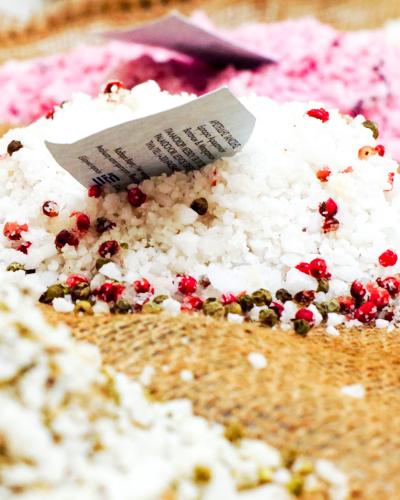
Its commercial recognition is based on its quality, unrefined form, and its combination with local herbs and spices offered by certain local packaging units.
The main production area is the Kalloni Salt Pans, located in the northern part of the Gulf of Kalloni, within administrative boundaries near the small town of Kalloni. This salt pan constitutes an extensive wetland (Special Protection Area, Natura 2000), which was created by the depositional processes of the Tsiknias River and the Xinorodos stream. This geomorphology, with low, flat coastal areas and a semi-enclosed marine zone, favors the creation of large evaporation basins. The geographical location ensures long periods of drought and sunshine, essential for the rapid and efficient evaporation of seawater and the crystallization of salt. A smaller, historic salt pan is also located at Skala Polichnitos, within the same gulf, which contributes to local production.
The production of sea salt on Lesvos follows natural solar evaporation on an industrial salt-pan scale, now using motorized equipment, while preserving the traditional core process.
Collection Method (Salt Pans)
- Seasonality and Preparation: The “cultivation” of the salt pan traditionally begins on April 1st, with the preparation of the basins (reservoirs and crystallization ponds) and the gradual introduction of seawater. The water is transferred from the gulf to the reservoirs where the initial evaporation begins and the brine density increases.
- Crystallization: The denser brine is directed to the crystallization ponds, where, due to the intense summer sunshine, the water evaporates completely and the sodium chloride crystallizes on the bottom.
- Harvesting: The salt is traditionally collected on September 1st. Today, the collection is carried out with motorized equipment (special extraction machines) that remove the layer of crystals. In the past, the extraction, gathering, and loading work required numerous laborers. At the Polichnitos Salt Pan, rail carts were historically used to transport the salt from the crystallization ponds to the collection area.
Processing
Lesvos salt is essentially unrefined. After harvesting, it undergoes a washing process to remove foreign matter, mud, and aquatic organisms. Large units (Hellenic Saltworks S.A.) produce washed salt, which can then be milled (coarse, semi-coarse, powder) and standardized (with the addition of iodine, if required). Local producers often sell the salt in its unrefined, natural form, frequently enriched with local aromatic herbs (e.g., oregano, thyme) or lemon zest, maintaining high levels of its natural trace elements.
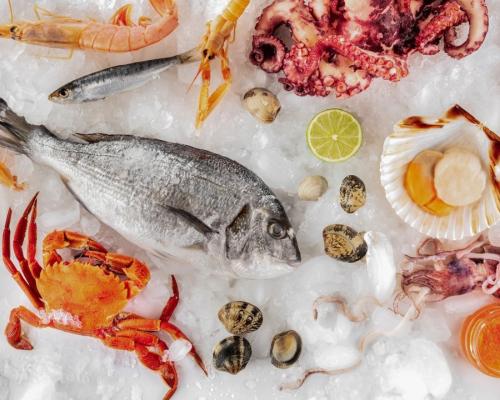
The Kalloni Salt Pans have a dual, critical impact on Lesvos: economic and ecological. From an economic point of view, the Kalloni Salt Pan constitutes one of the most important productive pillars of the island. Its operation, belonging to the company Hellenic Saltworks S.A., ensures the production and processing of a basic product on a large scale, contributing to employment (albeit reduced due to mechanization) and to exports. On the other hand, salt production is directly linked to traditional Lesvian gastronomy, as this salt is essential for the production of Lesvos’ renowned salted fish products (e.g. Kalloni sardines).
Beyond the economic impact, the saltworks constitute a wetland of global significance, included in the Natura 2000 network. This coexistence of industrial production and ecological protection is unique. The wetland hosts dozens of species of migratory and endemic birds, such as Flamingos, Ferruginous Ducks, and Avocets, making the area an important birdwatching center and a source of mild tourism for the island.
The history of the saltworks on Lesvos is deeply rooted, with the existence of smaller salt pans already recorded in earlier times (Perama of the Gulf of Gera, Apothika). The Kalloni Saltworks, in their present form and scale, began intensive exploitation around 1925 as a private enterprise, while in 1945 they came under state control.
Salt production, before mechanization, was hard labor that employed numerous workers from the wider region of Kalloni and Polichnitos, who undertook the extraction, gathering, and loading of the salt. The cultural heritage is closely linked to the craft of “almirizo”—the use of raw salt for the preservation and salted curing of fish, especially the Kalloni sardine (Papillomimus kalonissa). Beyond trade, salt was also the basis for the island’s food security. The University of the Aegean has organized conferences and events (e.g., the European program “ALAS - All About Salt”), highlighting the historical and cultural value of the saltworks of Lesvos.
Lesvos sea salt, as an unrefined natural product, stands out nutritionally compared to common processed table salt (sodium chloride – NaCl) due to the presence of natural minerals and trace elements derived from seawater. While its main component remains Sodium Chloride (NaCl) at a rate of over 97%, its nutritional value lies in the secondary components.
The absence of bioactive compounds (e.g. proteins, carbohydrates) is to be expected, as this is an inorganic mineral. The consumption of sea salt, although it provides additional minerals, should be done in moderation, in accordance with the recommendations of the World Health Organization, due to its high sodium content.
Lesvos sea salt, as an unrefined natural product, stands out nutritionally compared to common processed table salt (sodium chloride – NaCl) due to the presence of natural minerals and trace elements derived from seawater. While its main component remains Sodium Chloride (NaCl) at a rate of over 97%, its nutritional value lies in the secondary components.
The absence of bioactive compounds (e.g. proteins, carbohydrates) is to be expected, as this is an inorganic mineral. The consumption of sea salt, although it provides additional minerals, should be done in moderation, in accordance with the recommendations of the World Health Organization, due to its high sodium content.