Wheat from Limnos
Lemnos bears the historical title of the “granary of the Aegean”, an epithet that highlights the uninterrupted and central role of wheat in the island’s economy and culture since antiquity. Agriculture, and in particular cereal cultivation, remains the most important production sector, with Lemnos being one of the few Greek island regions that has a surplus in cereal production. Cultivation focuses mainly on durum wheat (Triticum durum), which is used for the production of high-quality flours and pasta, while the island has preserved and is reviving unique local varieties that are excellently adapted to its particular soil and climatic conditions. The quality of Lemnos wheat is defined by its high protein and vitreous content, characteristics that make it highly sought after.
The uniqueness of Lemnos wheat lies in the survival and revival of the indigenous durum wheat varieties and in their qualitative characteristics, which are attributed to the island’s unique terroir.
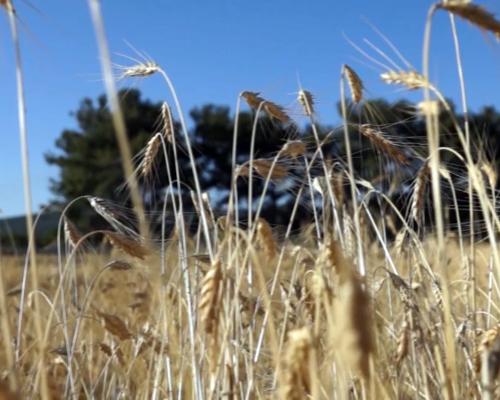
- Identification, Synonyms, Variants: The dominant cultivated species is Durum Wheat (Triticum durum). The best-known and historically established local varieties are “Lemnos” (or “Lemnos” Durum) and “Mavragani”. The ‘Lemnos’ variety is particularly known for its long stem, while ‘Mavragani’ is distinguished by its characteristic black ear. The ‘Lemnos’ variety has been referenced in scientific literature, and its revival in recent years represents a significant achievement for the island’s agricultural identity.
- PDO/PGI status: Lemnos wheat, as a primary crop, does not have official recognition as a PDO or PGI (Protected Geographical Indication) at European level. However, the local variety “Lemnos” has been recognized as a “conservation variety” in the National Catalogue of Varieties of Cultivated Plant Species, a fact that underscores its historical and genetic significance. In addition, certain processed products derived from Lemnos wheat bear agricultural identity certification (based on DNA and isotopic fingerprinting) for their place and variety of origin, thereby enhancing their protection and commercial value.
The cultivation of wheat on Lemnos extends across a large part of the island’s lowland and semi-mountainous areas. Lemnos is characterized by large, relatively flat expanses that favor the mechanical cultivation of cereals, in contrast to other Aegean islands.
The soils are mainly of volcanic origin, rich in minerals and with good water-holding capacity, despite the fact that the cultivation is almost exclusively rainfed (non-irrigated). The favorable climatic conditions for cereals, with sufficient winter rainfall and dry, sunny summers, contribute to proper ripening and to achieving a high vitreousness and protein content in durum wheat, characteristics that are particularly important for breadmaking and pasta production. The areas around Moudros and Kaminia are often cited as centers of high-quality cereal production.
The method of wheat cultivation on Lemnos combines modern techniques with traditional dryland farming, adapted to the specific requirements of local varieties.
- Sowing: Wheat is cultivated exclusively as a winter cereal. Sowing traditionally takes place between October and December, depending on the first autumn rains. Particular emphasis is placed on the application of crop rotation (alternation of crops, mainly with legumes such as grass pea or vetch), a practice that improves soil structure, enhances fertility (through nitrogen fixation by the legumes), and reduces the need for chemical inputs, thus preserving seed quality.
- Cultivation Techniques: Cultivation is primarily extensive and rainfed. Field management before sowing includes plowing after the first rains and tillage of the soil in order to maintain a crumbly surface, protecting the young plants from cold and drought. Wheat nutrition is based mainly on the rational use of fertilizers, guided by the needs of the local varieties, which generally show greater resistance to adverse conditions compared with improved commercial varieties.
- Harvesting: Harvest takes place in summer, usually in June or July, using modern combine harvesters. The hot, dry period contributes to the uniform and complete ripening of the grain.
- Processing / Standardization: After harvest, the grain is cleaned and stored. Part of it is used for seed production for the following year, while the greater part is sent for milling to produce flour. The producers of Lemnos often use stone mills, a traditional milling method that is considered to preserve 100% of the grain (germ, endosperm, bran) and its valuable nutrients (vitamins, dietary fiber) without overheating, thus enhancing the quality of the local durum wheat flours. Another portion of the grain is dehulled for use as whole wheat (e.g. in salads or kolyva).
- By-products: The main by-product is bran (husk), which is used primarily as animal feed, strengthening the island’s livestock sector (sheep’s milk and meat).
Wheat is the driving force of the agricultural and economic life of Lemnos.
- Economic Autonomy: Grain production makes Lemnos self-sufficient in basic raw materials and gives it economic independence, while the surplus is exported.
- Product Synergy: Wheat supplies all of the island’s secondary production. From it are made the renowned Lemnian pasta (flomaria, hylopites), traditional sweets (Samsades, Venizelika), and of course bread and rusks.
- Environmental Conservation: The preservation and revival of local cereal varieties, combined with the application of crop rotation with local legumes, contributes to the in situ conservation of the island’s genetic material, a critical element for agricultural biodiversity.
Lemnos’ relationship with wheat is lost in the mists of time, making cereal cultivation part of the island’s DNA.
- Antiquity and Byzantium: Lemnos has been mentioned since antiquity as “leion” (a place with ears of grain), with one interpretation attributing the island’s name to this characteristic. During the Classical period, through the Athenian cleruchies, Lemnos was the granary of Attica. This tradition continued in the Byzantine era, with the island supplying Constantinople with grain.
- Aristotle: There are references that even Aristotle mentioned the quality of Lemnos’ wheat variety, underscoring its historical value. This age-old tradition explains why wheat and its products constitute the core element of Lemnian nutrition and agricultural identity up to the present day.
Wheat is at the heart of many religious and social customs of Lemnos.
- Koliva: Hulled wheat is the main ingredient of koliva, which are traditionally prepared for the commemoration of the dead, constituting a primordial ritual custom.
- The Wheat Harvest: Although harvesting is now mechanized, in the past the wheat harvest was an important social celebration marking the end of an agricultural season, with the participation of the entire community.
The durum wheat of Lemnos, and in particular the local variety “Lemnos,” displays excellent quality characteristics, ideal for the production of high-quality foods.
The durum wheat of Lemnos, and in particular the local variety “Lemnos,” displays excellent quality characteristics, ideal for the production of high-quality foods.