Lesvos Chachles
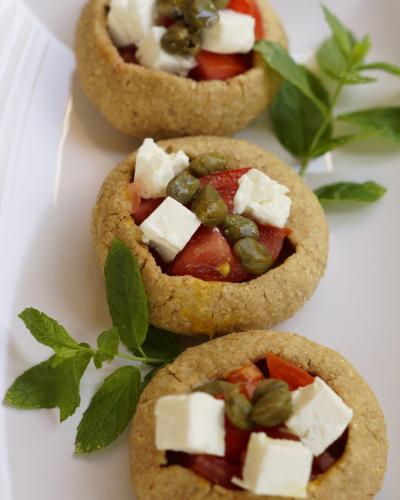
Lesvos Chachles are one of the island’s quintessential traditional foods, essentially a distinct and unique form of trahana (a pasta made from wheat and milk). This product is not merely a pasta, but a hard, dry formation made on the basis of sour trahana, which, however, takes on a characteristic cup, little boat, or nest shape. Their production is closely linked to the livestock‑farming tradition of Lesvos, as their main ingredient is local sheep’s milk, which sours naturally, giving the trahana its distinctive taste. The preparation process, which even today is carried out mainly by traditional methods by local producers and women’s cooperatives, reflects the island’s rural identity and gastronomic heritage.
Chachles are a unique variation of trahana, differing from classic rubbed (granular) trahana both in shape and in the manner of consumption that this shape entails. Their name derives precisely from their characteristic shape, which resembles a small boat or a flat, oval saucer for coffee cups. The main ingredients are cracked, coarse wheat (the so‑called “kourkouti”) and local sheep’s or goat‑and‑sheep’s milk that has undergone fermentation, making the trahana sour.
Their production is part of the broader tradition of Greek traditional products, with other Lesvos products such as Ladotyri Mytilinis (PDO) and Ouzo Mytilinis (PGI) having gained recognition. This underscores their importance as a local delicacy with a strong geographical and traditional identity, although without official European protection at this time.
Hachles are traditionally associated with the entire island of Lesvos (Mytilene), but particular emphasis in their production is placed on the island’s livestock-farming areas, mainly in southwestern Lesvos, such as Mesotopos and Agra. This geographical link is not random, as their preparation requires plentiful, high-quality sheep’s or sheep-and-goat’s milk, which is ensured by the extensive livestock units of the countryside. The island’s soil and climatic conditions, with abundant sunshine during the summer months, are vital for the product’s drying process. Their slightly sour taste reflects the use of local milk that has undergone natural fermentation, as well as the influence of local wheat, both of which are products of Lesvos’ land.
The production of Lesvos Hachles is a traditional, seasonal process, which usually takes place at the end of the summer, after the harvest and before the first autumn rains.
Traditional Production Method
- Milk Preparation and Fermentation: Local sheep’s milk (or a sheep-and-goat’s milk blend) is collected. The milk is boiled on the first day, cooled, and left in large, tinned copper cauldrons or containers for several days (usually 7–15), so that it sours and turns into sour milk or yogurt through natural fermentation by the milk cultures, with fresh, cold milk often being added daily.
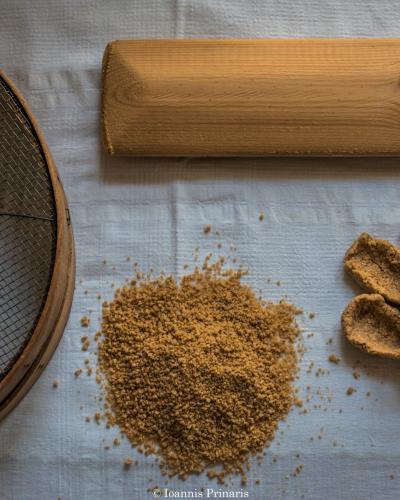
- Wheat Preparation: The wheat (grain) is coarsely cracked in stone mills or by another traditional method, creating the “kourkouti”.
- Boiling and “Trachanisma”: The soured milk is boiled in the cauldrons for several hours. As it boils, it thickens. Once removed from the fire, the kourkouti is gradually added in a specific ratio (about 1 part kourkouti to 3–5 parts milk), together with salt. This is followed by the “trachanisma”, the strenuous process of stirring carried out by the so-called “trachanitzides” (men with muscular strength) until the mixture becomes quite firm and the kourkouti is absorbed, creating a compact dough of sour, coarsely ground trachanas.
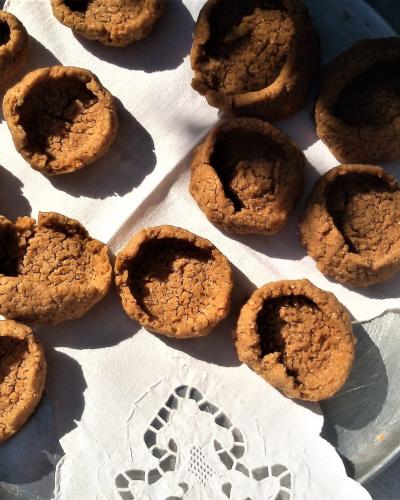
- Shaping the Hachles: After the mixture has cooled (usually the next day), the village women take over. They take small portions of the dough in the palm of their hand and shape them by hand, giving them the characteristic hollow cup/boat-like form.
- Drying and Storage: The Hachles are spread out on large racks or clean surfaces (e.g., rooftops) and left for 3–7 days under the strong Lesvos sun to dry completely and harden, determining the final product. Climate and sunshine are decisive factors. After complete drying, they are stored in cloth bags or dry tins.
The production of Hachles has a significant economic, social and cultural impact on Lesvos. Economically, it strengthens local livestock farming (due to the demand for local sheep’s milk) and small-scale agricultural processing, as their preparation often takes place in small family-owned facilities or, increasingly, in women’s cooperatives (e.g. in Agra). These cooperatives play a decisive role in preserving the traditional production method, in promoting the product, and in supporting women’s employment in rural areas, contributing to the stimulation of the local economy and the preservation of the rural population. Culturally, Hachles serve as an ambassador of Lesvian gastronomy and traditional Mediterranean diet.
Trahanas, the base of Hachles, is one of the oldest processed foods of the Eastern Mediterranean, with its history dating back to antiquity. In Lesvos, Hachles constitute a local evolution of this tradition, which developed within the framework of the self-sufficiency of farming and herding households. Their production in September was a collective and laborious process that marked the beginning of winter and the securing of food for the cold months. Their high nutritional value and the ease of storage and transport made them a staple component of the diet of farmers and herders. The presence of the characteristic cup/boat shape in Lesvos, as opposed to the granular trahanas of other regions, indicates a deeply rooted, locally evolved practice that is passed down from generation to generation, forming part of the island’s intangible cultural heritage.
The production of Hachli was linked to an important custom of cooperation and collective work in the villages of Lesvos, mainly in September. The entire process, from boiling the milk in large cauldrons to shaping it, was a ritual in which the whole family or neighborhood took part. The men undertook the demanding “trachanisma,” while the women possessed the skill of shaping the hachli and overseeing the drying process. The smell of boiled milk and trahana filled the villages, serving as a true olfactory hallmark of the season. Production was not only a means of survival but also an opportunity for social interaction and for preserving family bonds and traditional knowledge.