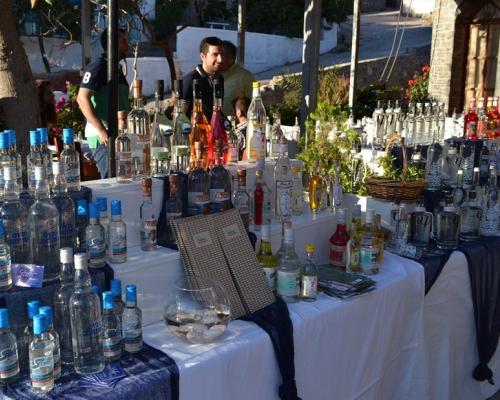
Tsipouro
Tsipouro is a traditional Greek distillate, also known as raki or tsipouro, which is produced from grape pomace, that is, the residues of winemaking (skins, seeds and a small quantity of must). In Lesvos, although the island’s dominant alcoholic identity is Ouzo (due to its long tradition in distillation and the unique microclimate that favors anise), Tsipouro is also produced, especially for household use or by small producers, and is directly linked to the island’s viticulture. Its production in Lesvos constitutes a cultural link with the vineyard and the harvest season, while it often differs from mainland tsipouro due to the use of local grape varieties such as Muscat of Alexandria and Limnio (from vineyards on Lemnos that belong administratively to Lesvos).
Tsipouro of Lesvos, although overshadowed by Ouzo, maintains its uniqueness through the traditional process and the local raw materials.
- Identification, Synonyms, Variations: The official name is Tsipouro. In Lesvos and in other Aegean islands, the term Souma is also used to describe a similar pomace distillate, often without anise and intended for immediate consumption.
- Basic Specifications: Tsipouro is produced exclusively from the distillation of fermented grape pomace. Alcohol content must range between 37.5% and 45% vol. The use of aromatic seeds (such as anise, fennel, mastic) is optional, with “pure” tsipouro being without aromas and the flavored type being the other variation.
The production of Tsipouro in Lesvos is directly linked to the island’s viticultural zones.
The main areas where Tsipouro is produced (as a by-product of winemaking) are the regions around Plomari, Agiasos and Kalloni, where wineries and vineyards are found. The pomace comes from varieties cultivated in the soils of Lesvos, including local varieties or even varieties grown for the production of Ouzo (aromatic pomace). The volcanic soil and the maritime climate of Lesvos, which affect the grapes, ultimately convey some of their organoleptic characteristics to the final distillate.
The production of Tsipouro on Lesvos, especially in its traditional form (souma), follows ancient techniques, although industrial units use modern equipment.
- Fermentation of Grape Pomace: After winemaking, the grape pomace (which contains residual sugars) is collected and placed in barrels to initiate alcoholic fermentation, which converts the residual sugars into ethanol. This process usually lasts several weeks.
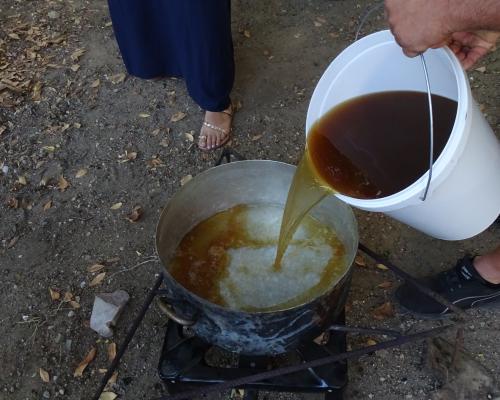
- Distillation: Distillation is carried out in traditional copper stills (kazánia). The process is slow and requires particular attention to ensure quality. The key to a quality tsipouro is the separation of the fractions.
- Heads: The first part of the distillate (heads) has a high content of volatile, undesirable substances (e.g., methanol) and is discarded.
- Heart: The middle fraction (the “heart” of the distillate) is the desired one, with the best aromatic and taste characteristics.
- Tails: The last fraction (tails) has a lower content of alcohol and aromatic compounds, and is usually returned to the next distillation cycle.
- Flavouring (Optional): While Lesvos Ouzo is obligatorily flavoured with anise, Tsipouro can be produced with or without aromatics. When aromatics are used, they are added together with the grape pomace during distillation. On Lesvos, in addition to anise, local aromatics such as fennel, clove, cinnamon or mastic can be used, depending on the producer’s tradition.
- Maturation (Optional): Tsipouro is usually consumed immediately, but some producers, especially for bottled tsipouro, choose to mature it in oak barrels for several months or years. This process imparts complexity, softens the perception of alcohol, and adds aromas of vanilla and spices.
The production of Tsipouro on Lesvos, although on a smaller scale than Ouzo production, contributes to the complementary utilization of agricultural products and to the preservation of the rural character of certain areas.
The distillation of grape pomace constitutes a closed production cycle (from the vineyard to the wine and then to the distillate), contributing to zero waste of the by-products of winemaking. The activity of the “two-day distillers” (stills) strengthens local social cohesion and provides a source of supplementary income for vine growers and small winemakers.
The tradition of distilling grape pomace has its roots in Byzantine times and developed especially in the Greek lands, mainly in the monasteries.
On Lesvos, the production of souma (the local version of tsipouro) is a centuries-old practice. The development of Tsipouro on Lesvos is closely linked to the island’s viticulture and the farmers’ need to use all by-products of the grape harvest. The distillation process, especially for small producers, maintains its ritual and communal character, passing on know-how from generation to generation.
Tsipouro (or Souma) on Lesvos is primarily associated with the “kazanemata” (distilling gatherings) and the autumn table.
- The Cauldrons: Distillation in traditional cauldrons (stills) is an important social event in the autumn. Friends and relatives gather, the process is accompanied by music, dancing, and the consumption of meze (mainly meat dishes) with the freshly distilled tsipouro. This custom is one of the island’s most important rural festivals.
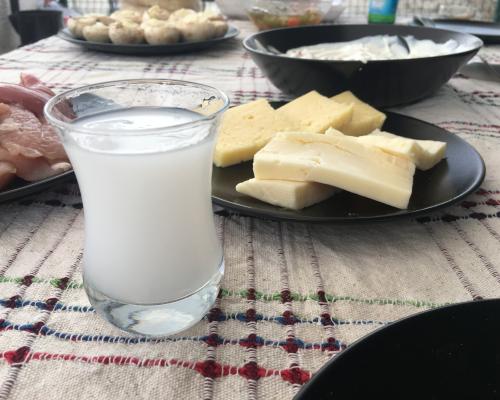
- The Treat: The “pure” tsipouro (souma) is often used as a welcome drink in country homes in Lesvos and is accompanied by simple meze, such as olives, tomato, or rusks.
The pursuit of distinctions concerns mainly branded bottled tsipouro produced by distillers of Lesvos.
- Competition: Thessaloniki International Wine and Spirits Competition
- Category: Grape Marc Distillate (Tsipouro)
- Level: Gold/Silver Medal
- Competition: World Spirits Awards / IWSC
- Category: Grape Pomace Spirit
- Level: Bronze/Silver