Souma of Chios
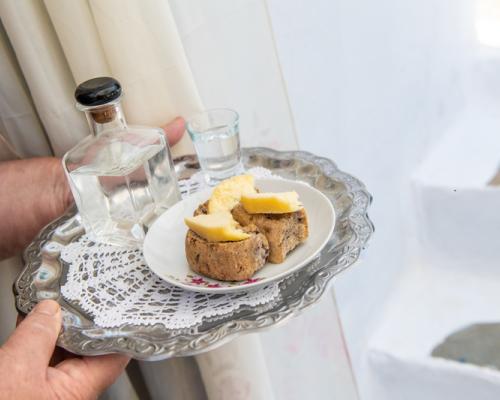
Souma of Chios is a traditional, colorless and intensely aromatic spirit, produced exclusively on Chios by distilling fermented figs. In contrast to tsipouro or tsikoudia, which use grape pomace as their raw material, Souma differs fundamentally, as it is derived from the fruit of the fig tree, giving it a distinctive and unique flavor profile, traditionally free from the addition of aniseed. It is a pure distillate (locally also referred to as “to anempikarisma”) whose production is linked to a deeply rooted ritual and social event on the island, mainly in the mastic-producing villages, preserving an age-old method of preparation.
Souma of Chios, or simply Souma, is clearly identified as a fig distillate. It is a product whose alcohol content, although varying depending on the producer, usually ranges between 45–50% vol., a characteristic of traditional Greek spirits. Its uniqueness lies in its raw material, figs, and in the absence of aromatic additives such as aniseed, which is often used in other spirits (e.g. ouzo or certain types of tsipouro/raki), a fact that allows the natural, fruity aromas of the fig to dominate.
The production of Souma is inextricably linked with the island of Chios, with a particular tradition mainly in the Mastic Villages and, more generally, in the rural villages of the island. Mesta, in particular, is mentioned as an area with deep roots in the history of Souma, regarded by locals as its local place of origin. The geographical area of production is, therefore, the entire island of Chios, where local fig varieties are cultivated and harvested, forming the primary and main raw material for the distillate. The quality of the distillate is directly influenced by the island’s soil and climatic conditions, which favor the production of figs with high sugar content, essential for fermentation.
The production of Souma follows an age-old and traditional method, which is based on a discontinuous copper still (the “kazani”), heated with wood. The process begins with the harvesting of figs, usually in late August.
- Preparation of Raw Material (Rembikia): The figs are left in the sun for about 20 days, so that they dry slightly and concentrate their sugars. They are then transported to the distilleries (or “kazanias”), where they are moistened and mixed with yeast.
- Fermentation: The mixture of figs and water (“rembikia” or “rembiki”) is left to ferment for about 15 days (or two weeks), during which the sugars are converted into ethyl alcohol.
- Distillation (Kazanisima or Anembikarizma): The fermented material is placed in the copper alembic, together with water and, occasionally, aromatic herbs or other fruits, such as orange, although traditional Souma is a pure fig distillate. The still is insulated, the fire is regulated and the boiling begins. As the material is heated, the alcohol evaporates and is led through an arch to the condenser, where the vapors are cooled and the Souma is collected.
- Distillation Fractions: During distillation, the output is separated into three fractions:
- Head: The first 2–3 liters of distillate, with a very high alcohol content and volatile substances (methanol), which are unsuitable for consumption and are usually discarded.
- Body (The Souma): The main and highest-quality part of the distillate, with the desired alcoholic strength and the rich fig aromas. This is the final beverage.
- Tail: The last part of the distillate, with lower alcoholic strength and undesirable components, which is poured back into the boiler for redistillation.
- Distillation Stages: The process can be carried out in one or two stages, with double distillation yielding a cleaner and more refined final product. The term “anembikarizma” in the Chian dialect refers to the distillation process itself.
Souma is an important element of the economic and social life of Chios, especially for the rural population and fig producers. Although its production largely remains family-based and for personal use, the distillation tradition creates seasonal employment and, above all, strengthens the local market by making use of figs, which are a significant agricultural product of the island. The social impact is even stronger, as the distillation process turns into a celebration and social gathering, keeping alive an old custom and the cultural identity of Chios. Recognition of the product could offer new prospects for promoting the island as a tourist destination.
The distillation tradition in Chios, and particularly that of Souma, is ancient. The use of the copper still to convert the sugars of the fruit into alcohol is a method that dates back centuries. Souma is not just a drink, but a part of the island’s folklore, closely connected with the cycle of rural life. Its production usually takes place after the harvest, in the months of October and November, marking the end of the agricultural season and the beginning of social relaxation and entertainment. The history of Souma is reflected in old practices, such as the use of the “bournia” (a clay vessel) for collecting the distillate in earlier times.
The “Kazánisma” or “Anebikárisma” of Souma is one of the liveliest and most beloved customs of Chios. The distillation process transcends its simple technical nature, turning into a spontaneous celebration with strong social characteristics.
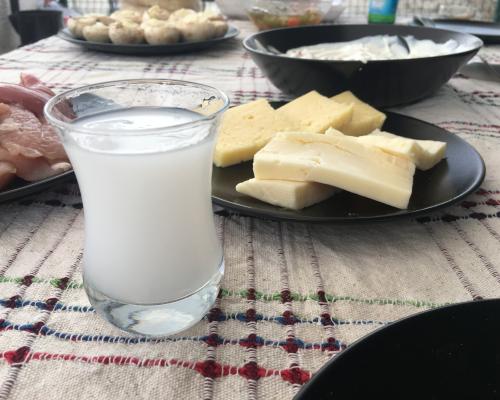
- The social feast: When the cauldron is filled and the boiling begins, the producers and their friends gather around the still. The feast includes live music, songs (often amanés) and, above all, plentiful meze that are consumed while waiting for the Souma to start flowing. Every passerby is welcome and treated, in keeping with the tradition of hospitality.
- Souma Festival: Many villages, such as Mestá and Leptópoda, organize annual Souma Festivals in the autumn months, where the distillation process is publicly revived, attracting crowds of people and tourists.
- Local customs: Souma is also incorporated into other traditions, such as the custom of the Agás in Olympos and Mestá on Clean Monday, where the “condemned” person often drinks souma as part of the fine.
Specifications
The following is a recorded traditional practice:
- Raw Material: Fermented figs (mainly dried).
- Alcohol Content: Usually 45–50% vol. (Comparison: Tsipouro must have at least 37.5% vol).
- Distillation Method: Copper pot still, batch operation, usually wood-fired.
- Aromatization: Traditionally without anise. Some producers add small amounts of aromatic herbs or fruits (e.g. orange) to the cauldron.
- Fraction Separation: Essential separation of the “Head” and the “Tail” in order to achieve a high-quality “Body.”
As a pure distillate, Souma, like tsipouro, consists mainly of ethyl alcohol and water, with very small amounts of other volatile compounds that give it its aroma and taste.
- Calories: Its caloric value comes almost exclusively from the alcohol. For a 45% vol distillate, the calories are calculated at approximately 100–110 kcal per 50 ml (one shot).
- Macronutrients: It contains virtually no carbohydrates, sugars, proteins, or fats, as these have been removed during distillation.
- Bioactive Compounds: The quality of Souma is judged by its content of volatile compounds, apart from ethanol, such as:
- Higher Alcohols: (e.g. isobutyl, isoamyl) which contribute to the aroma.
- Esters and Aldehydes: (e.g. ethyl acetate) which impart fruity and aromatic notes, originating from the fermentation of figs.
- Methanol: The methanol content must be within legal limits (although there are no specific specifications for Souma, the general limits for distillates are followed, e.g. up to 1,000 grams per hectoliter of 100% vol alcohol, as is the case for tsipouro).
In summary, the nutritional value of Souma is similar to that of any pure distillate, with its distinctive aromatic complexity being due to the unique volatile components of fermented fig.
As a pure distillate, Souma, like tsipouro, consists mainly of ethyl alcohol and water, with very small amounts of other volatile compounds that give it its aroma and taste.
- Calories: Its caloric value comes almost exclusively from the alcohol. For a 45% vol distillate, the calories are calculated at approximately 100–110 kcal per 50 ml (one shot).
- Macronutrients: It contains virtually no carbohydrates, sugars, proteins, or fats, as these have been removed during distillation.
- Bioactive Compounds: The quality of Souma is judged by its content of volatile compounds, apart from ethanol, such as:
- Higher Alcohols: (e.g. isobutyl, isoamyl) which contribute to the aroma.
- Esters and Aldehydes: (e.g. ethyl acetate) which impart fruity and aromatic notes, originating from the fermentation of figs.
- Methanol: The methanol content must be within legal limits (although there are no specific specifications for Souma, the general limits for distillates are followed, e.g. up to 1,000 grams per hectoliter of 100% vol alcohol, as is the case for tsipouro).
In summary, the nutritional value of Souma is similar to that of any pure distillate, with its distinctive aromatic complexity being due to the unique volatile components of fermented fig.