Chios sheep
The Chios sheep, one of the most distinguished Greek breeds, is inextricably linked with the history and livestock-farming tradition of Chios. It is characterized by its excellent milk-producing ability and high prolificacy, which makes it particularly popular and sought after throughout Greece and abroad, not only for milk production but also for the improvement of other flocks. The breed, although its farming has now expanded to many regions of the country, preserves the distinct identity shaped on the Aegean island, constituting an important genetic resource for Greek livestock farming.
The Chios Sheep or Chios Breed is a large-sized, uniform-fleeced and semi-fat-tailed sheep breed, recognized for its high yields. The main uniqueness of the breed lies in its high milk production and prolificacy (many lambs per lambing), characteristics that make it one of the most productive and economically efficient breeds in Greece.
The breed has been officially recognized by the Ministry of Rural Development and Food as a Greek sheep breed, with its own Herdbook, a fact that underscores its national importance and the need for genetic improvement and conservation. The milk of the Chios breed is used in the production of various cheeses, some of which may bear PDO labeling, but the breed itself is not protected under this regime.
The Chios Breed (Chios Sheep) has its roots in the island of the same name in the North Aegean, Chios, where it was also developed. More specifically, its origin is traced to the southern lowland part of the island. Its creation is believed to have resulted from crosses between the local uniform-fleeced thin-tailed sheep of Chios and mixed-fleeced fat-tailed sheep, probably of Asia Minor breeds such as the Karaman or the Daglic. This genetic combination, together with the particular soil and climatic conditions of the island, contributed to the creation of a highly productive animal. Although the breed was developed in Chios, due to its reputation and high performance, its farming has now expanded significantly to other regions of Greece as well, mainly in Macedonia (such as in the prefectures of Kilkis, Thessaloniki, Chalkidiki, Imathia, Pella), but also in Thessaly, Central Greece and Epirus, where Chios Sheep Breeders’ Cooperatives operate for its genetic improvement.
The traditional breeding method for the Chios sheep on the island of Chios was historically the household system, particularly in Southern Chios, where each family maintained small groups of animals (up to 5 individuals) to cover its own needs for dairy products and meat. This practice indicates that the breed is difficult to adapt to large flocks and extensive systems, due to its nature.
In the modern farming systems applied today throughout Greece, due to the high requirements for milk production, breeding is essentially intensive or semi‑intensive. The high milk yield and prolificacy of the animals entail increased nutritional needs, which are covered, apart from the limited grazing on pastures, mainly through the provision of supplementary feeds of high nutritional value. Supplementary feeding is vital, especially towards the end of the gestation period and the early lactation period, in order to maintain high performance and good physical condition of the animals. An important aspect of management is also tail docking in female lambs a few days after birth, a practice applied by many breeders to address the morphological drawback of the conical tail, which may hinder natural mating and the milking of ewes.
The Chios sheep has been, and continues to be, a key pillar of Chios’s rural economy, particularly in the southern, lowland part of the island. Historically, its rearing under a household-based system covered families’ needs for meat and dairy products, strengthening food self-sufficiency. In addition, due to its high value, the Chios sheep was an important genetic export resource for the island, since up until the 1980s thousands of breeding lambs were exported to other regions of Greece and to Cyprus. Today, although the majority of animals bred are found outside Chios, the breed remains part of the island’s cultural and economic identity. The preservation and improvement of the breed on Chios contributes to the maintenance of local biodiversity and constitutes a product of high added value, linked to local gastronomy and the production of traditional dairy products.
The history of the Chios breed dates back at least to the 1940s, when the breed became widely known for its high yields, although its creation goes back to earlier crossings of local sheep with fat-tailed Turkish or Asia Minor sheep, a fact that reflects Chios’s geographical and commercial connections. Its development as a household animal in Southern Chios, reared in small groups, indicates a deeply rooted connection with rural family life.
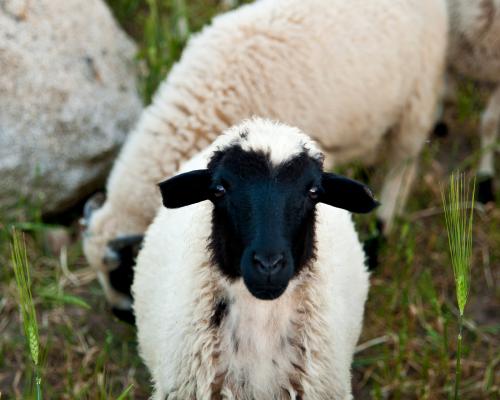
As cultural heritage, the Chios sheep represents not only a genetic reserve, but also the intangible heritage of traditional Aegean livestock farming. The knowledge and traditional practices surrounding breeding, feeding, and the utilization of milk for the production of local cheeses constitute an integral part of the rural culture of Chios. The distinctive appearance of the breed, with its white color and characteristic black spots on the face and extremities, is a recognizable symbol that is also found in the island’s rural folklore.
The most important events that marked the rhythm of life of the Chian sheep farmer were:
- Lambing: The lambing period, due to the high prolificacy of the Chios sheep, was always an important event that required special care and a special diet for the ewes. The management of the numerous lambs and the safeguarding of their survival constituted a laborious but joyful period.
- Milking and Cheesemaking: Milking marked the beginning of the dairy season, which, due to the high productivity of the breed, was extended. The milk was used immediately by the family for the preparation of yogurt, butter, and traditional cheeses, which formed a basic part of their diet.
- Shearing: The shearing of the wool, despite the low quality and quantity of the breed’s fleece, was a traditional social event in which relatives and neighbors often took part, turning the process into an opportunity for gathering and celebration.
The Chios breed as a livestock genetic resource has received recognition mainly in the field of genetic improvement and high productivity at both national and international level.
- Recognition as a Genetic Resource: The breed is officially recognized by the Ministry of Rural Development and Food and the Agricultural Cooperative of Sheep Breeders of the Chios Breed “MACEDONIA” for its genetic improvement and conservation program, which indicates its high genetic value.
- International Reputation: The breed is known internationally as one of the most productive Greek sheep breeds and has been widely used for crossbreeding and reproduction in Mediterranean countries and beyond.
The high content of solids and proteins improves rennet coagulation capacity, making the milk of the Chios sheep an excellent raw material for the production of traditional Greek cheeses, such as feta and yogurt.
The high content of solids and proteins improves rennet coagulation capacity, making the milk of the Chios sheep an excellent raw material for the production of traditional Greek cheeses, such as feta and yogurt.