Ergolavoi
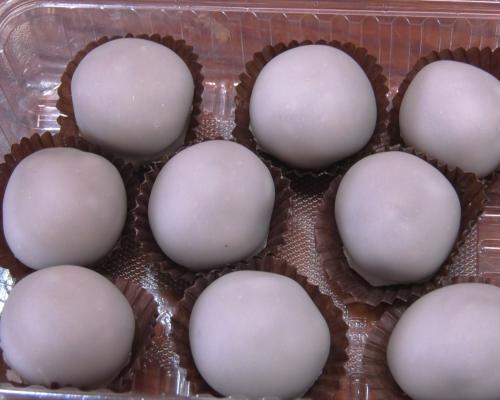
Ergolavoi are one of the most classic and beloved almond confections in Greek pastry-making, with a special place and historical link to the gastronomy of Lesvos. This is a sweet based on ground almonds and meringue (egg white with sugar), which is baked gently in order to preserve a characteristic texture: crisp on the outside and soft, chewy on the inside. In Lesvos, Ergolavoi belong to the broader category of island-style almond sweets, where almond cultivation thrives, and are often filled with cream or jam, while being decorated with a roasted almond. On the island, these sweets are closely associated with great celebrations and customs, serving as the official treat at weddings and engagements.
Ergolavoi are a special type of baked almond sweet (in contrast to the raw almond confections of the Cyclades), often referred to as the Greek version of the French macaron, due to the similar base (meringue and ground nuts). In Lesvos, although the sweet is known by its nationwide name, it is part of the tradition of “Gemata” and “Prospesmata”—the almond confections prepared for joyous occasions.
The uniqueness of Ergolavoi, as they are traditionally prepared in Lesvos, lies in:
- Texture and Shape: They maintain a balance between a crisp crust and a soft, almost chewy interior, something that requires precise baking temperature and time. Their shape is usually round or slightly pear-shaped, although the final form is typically two cookies joined together with a filling, forming a “sandwich.”
- Connection with Bitter Almond: The addition of a small quantity of bitter almond, which thrives in the Aegean, enhances the almond aroma and imparts the characteristic, slightly piquant flavor that distinguishes traditional almond sweets.
The sweet Ergolavoi is closely tied to the gastronomic tradition of Lesvos, where the preparation of almond confections is a key element of pastry-making, mainly due to the strong Asia Minor heritage and influence.
The geographical identity of the sweet in Lesvos is reinforced by the use of local raw materials, such as:
- Lesvos Almonds: Lesvos, as an Aegean island, has almond orchards, whose fruit is a basic ingredient of island pastry-making.
- Orange blossom water: The traditional sprinkling of almond cookies with orange blossom water or rose water (often made by the nuns of the Holy Monastery of Myrsiniotissa) is a local element that links the Ergolavoi with the broader tradition of Lesvos almond sweets (Gemata).
While the sweet is known throughout Greece, on Lesvos it retains its traditional connection with local customs and pure raw ingredients, distinguishing it from the commercial variants found in urban centers.
The traditional method of producing Ergolavoi is based on the simplicity of the ingredients (almond, sugar, egg white) and the precision of the process, in order to achieve the desired dual texture.
- Preparation of Almond Meal: The blanched white raw almonds (after scalding and peeling) are ground together with the icing sugar and, possibly, a small amount of flour and bitter almonds, until they become a fine powder.
- Preparation of Meringue: The egg whites are beaten with granulated sugar and a pinch of salt until they form a stiff meringue. This stage is crucial for the subsequent texture of the biscuit.
- Homogenization: The meringue is gently and gradually incorporated into the almond mixture using a plastic spatula (maryse), with movements from bottom to top, so as not to deflate the air in the meringue. The final mixture should be airy yet stable.
- Shaping and Baking: The mixture is transferred to a piping bag and shaped into small, round or pear-shaped discs (2–3 cm in diameter) on baking paper. An almond is placed in the center for decoration. Baking is gentle (e.g. 160–180°C with fan) and brief (17–25 minutes) so that the Ergolavoi develop a crisp surface while remaining soft and chewy on the inside.
- Assembly and Finishing: Once cooled, one disc is spread with jam, praline, or cream (classic vanilla or chocolate) and joined with a second, creating the characteristic “sandwich.” Finally, they are sprinkled with orange blossom water and dusted with icing sugar for the traditional finish.
The production of Ergólavos and almond-based sweets in general in Lesvos has a significant cultural and economic impact, as it is directly associated with:
- Preservation of Tradition: The Women’s Agritourism Cooperatives and the local bakeries/pastry shops of the island keep the traditional recipe alive, contributing to the preservation of the local gastronomic heritage.
- Promotion of Almonds: The steady demand for almond sweets strengthens the local market for almonds and bitter almonds in Lesvos.
- Touristic Promotion: Together with the other traditional products (ouzo, olive oil, ladotyri cheese), the Ergolavos sweets serve as a gastronomic souvenir, attracting tourists who seek authentic local flavors.
The history of the Ergolavos sweet is complex and linked to two main currents: the Mediterranean almond confection and modern Greek urban history.
On the one hand, Ergolavos belongs to the family of Amaretti (Italy) and Acibadem (Turkey) and the French macaron, which share as a common denominator the use of almonds and meringue. This tradition came to Lesvos, as to other islands, through strong commercial and cultural ties with Asia Minor and Constantinople.
On the other hand, the Greek name “Ergolavos” (“Contractor”) is said to have become established in Athens in the 1960s, during the era of large-scale reconstruction. There is a rumor that this sweet was offered as a treat in offices when contracts for property exchanges (between landowners and builders/contractors) were signed, as it was tasty, easy to transport, and kept for many days. On the islands, such as Lesvos, this sweet remained known also as simple “baked almond sweet,” yet the name “Ergolavos” prevailed due to its popularity.
In Lesvos, Ergolavoi and the broader category of baked almond sweets are inextricably linked with wedding and engagement customs.
- Sweet of the “Promise” (Engagement): Almond sweets were the traditional sweet that accompanied the promise of marriage. The bride brought the almond sweets (“prospesmata”) to her mother-in-law so they could be offered to the guests at the engagement celebration, symbolizing purity and the wish for a sweet life for the future couple.
- Dowry and Occasions: Almond sweets (such as “Gemata”) were offered as “peskesi” (gifts) to relatives and important persons.
- Sprinkling with Orange Blossom Water: The ritual of sprinkling the almond sweets with orange blossom water or rose water (distillate of bitter orange blossoms or rose blossoms) is an island custom that links them with celebration and purity.