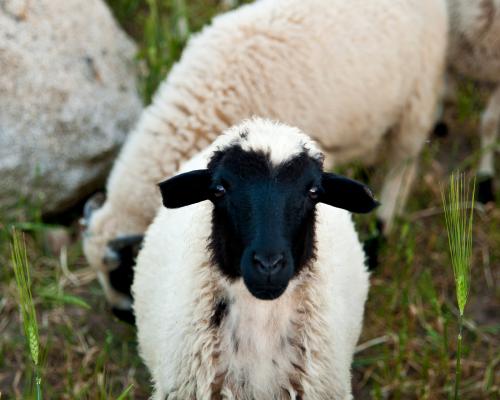
Eudilos Ikaria sheep
The Eudilos Ikaria sheep is a locally adapted indigenous breed that takes its name from the region of Evdilos, where historically its largest populations were concentrated. The breed is classified among the rare sheep breeds of Greece that are at serious risk of extinction, according to official academic records. It is characterized as an animal of medium to large body size, white in color, and it is first mentioned in the 1960s. Its value does not lie in high milk or wool yields, but in its resilience and adaptability to the harsh geomorphological and climatic conditions of Ikaria.
The uniqueness of the Eudilos breed lies in its morphological and productive traits that arose from the island’s centuries-long isolation and natural selection.
- Identification/Synonyms: Eudilos Ikaria Sheep.
- PDO/PGI status: The breed is categorized as in a “Critical” state by conservation organizations, as the total population of purebred animals is estimated to be fewer than 50 individuals, making its conservation a priority for national livestock farming.
- Basic Morphological Characteristics:
- Size: Medium to large. Average height at the withers approximately 74 cm for rams and approximately 66 cm for ewes.
- Head & Horns: Rams bear strong spiral horns, while females are usually polled or with rudimentary horns. The head is small and fine.
- Tail: Conical, fairly long and relatively broad, characterizing the breed as semi-fat-tailed.
- Productive Characteristics: Milk production amounts to approximately 150 kg per lactation, while the prolificacy index (lambs per lambing) is about 1.5, values that are relatively low but typical for indigenous breeds raised under adverse conditions.
Breeding of the Evdilos breed, although historically focused in the Evdilos area, is today scattered in a few household flocks throughout Ikaria, with some small populations found in the Mesaria region.
- Soil and Climatic Conditions: The Evdilos breed has developed the ability to survive and perform in the semi‑arid environment, exploiting the poor herbaceous and shrubby vegetation.
- Connection with Orchards and Vineyards: Historically, the breed performed better when raised as a household animal in the adjacent orchards and vineyards of the island, where it found supplementary feed, a fact that explains its close connection with the traditional agricultural landscape of Ikaria.
The rearing method of the Evdilos sheep in Ikaria is distinctive and aims mainly at meat production, with minimal expenses and management. Traditionally, rearing was household-based (small flocks to cover the family’s needs), whereas today it is mainly semi‑extensive: the animals graze freely in the pastures and orchards of the island. Their diet is based on the natural pastures of Ikaria, with basic feed supplementation (hay, concentrates) provided only during the last month of gestation and the first months of lactation to boost performance. Livestock farming focuses primarily on the production of lamb and mutton, while the milk is used for local cheeses such as Kathoura. Lambs are usually slaughtered immediately after weaning, at about 60 days of age and a body weight of approximately 15–18 kg.
The Evdilos breed, although with a critically reduced population, has a significant impact on the economy, biodiversity, and cultural identity of Ikaria.
- Biodiversity Conservation: The breed is an integral part of Ikaria’s agricultural ecosystem. Its preservation is critical for maintaining genetic material that is adapted to local conditions and for avoiding the loss of a unique animal resource.
- Production of Local Products: The breed is the basis for the production of local meat (lamb) and traditional cheeses (Kathoura), contributing to the autonomy and added value of Ikaria’s agricultural products, which are linked to the island’s reputation for longevity.
Animal husbandry in Ikaria, and with it the Evdilos breed, has a long history. The agricultural isolation and the particular social structure of the island allowed the breed to retain its characteristics without intensive crossbreeding until recent decades. The older inhabitants of the island report that the breed has always been limited in number, as it was more sensitive to movement compared to the local goats (raska) and performed better under household farming. The history of the breed is connected to sustainable, family-based food production.
The customs relating to the Evdilos sheep form part of the island’s broader livestock-raising practices.
- Ikariotiko Meat: The meat of the sheep, especially lamb, is the core of the festivals and major celebrations of Ikaria. Its preparation in large cauldrons or in the oven is an integral element of the island’s social life.
- Kathoura: The production of Kathoura (local cheese made from goat’s and sheep’s milk) is a traditional process directly linked to the rearing of the island’s sheep and goats, including the Evdilos sheep, and constitutes a dietary symbol of Ikaria.
Although there are no specialized studies on the nutritional analysis of the pure Evdilos breed, the quality of the meat and milk is positively influenced by extensive grazing on vegetation of high biodiversity. The meat (lamb/mutton) is considered leaner (lower in total fat) and has more intense organoleptic characteristics compared to animals from intensive farming, due to the transfer of aromas from the flora. It is rich in proteins of high biological value and has a favorable fatty acid profile, tending toward higher polyunsaturated fats (Omega‑3) due to the extensive rearing system.
The milk of the breed has low yield but a high content of solid components. Due to extensive farming, the milk (and local cheeses such as Kathoura) is rich in calcium and may contain higher levels of Conjugated Linoleic Acid (CLA), which is associated with health benefits.
Although there are no specialized studies on the nutritional analysis of the pure Evdilos breed, the quality of the meat and milk is positively influenced by extensive grazing on vegetation of high biodiversity. The meat (lamb/mutton) is considered leaner (lower in total fat) and has more intense organoleptic characteristics compared to animals from intensive farming, due to the transfer of aromas from the flora. It is rich in proteins of high biological value and has a favorable fatty acid profile, tending toward higher polyunsaturated fats (Omega‑3) due to the extensive rearing system.
The milk of the breed has low yield but a high content of solid components. Due to extensive farming, the milk (and local cheeses such as Kathoura) is rich in calcium and may contain higher levels of Conjugated Linoleic Acid (CLA), which is associated with health benefits.