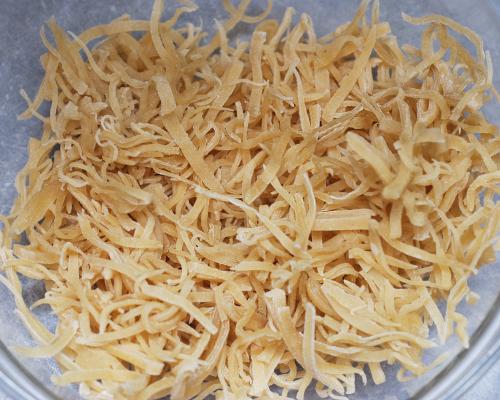
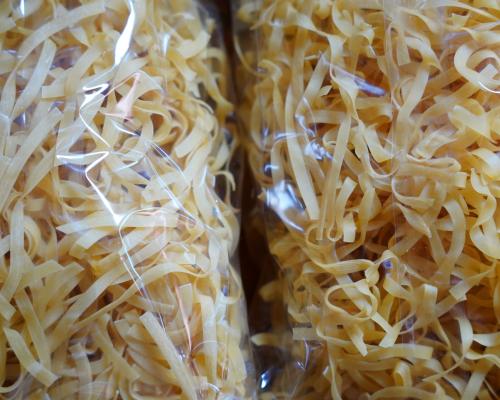
Handmade pasta (flomaria, trahanas)
Handmade pasta, such as flomaria and trahanas, are an integral part of the Greek rural and island dietary tradition, serving as basic food reserves for the winter months. On Agios Efstratios, their preparation with local ingredients such as flour from cultivated grains and milk from the area’s goats and sheep was an established practice. Beyond their nutritional value, these pastas embody the knowledge, labor, and social dimension of the inhabitants’ collective food preparation, reflecting a way of life based on self-sufficiency.
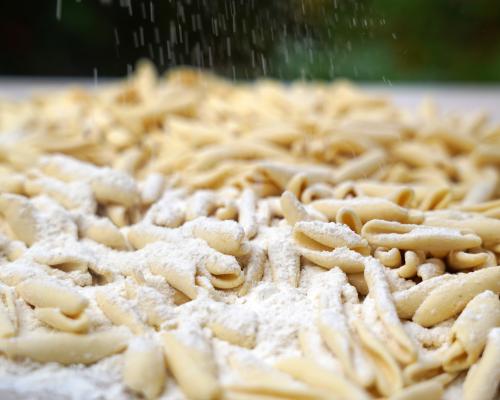
The flomaria and trahanas of Agios Efstratios are traditional pasta products. Trahanas is one of the oldest kinds of pasta in the world, a product of fermenting and drying a mixture of flour or semolina with milk (sweet trahanas) or yogurt (sour trahanas). Flomaria (or flomaria, synonymous) are thin, wide ribbon-like pasta, similar to hilopites, but traditionally made with fresh milk and plenty of eggs, ingredients that were abundant in livestock-farming communities.
Specifications
- Flomaria: Traditional recipe that includes flour from local grains, fresh milk (mainly sheep’s or goat’s milk due to the island’s livestock farming) and eggs. They are characterized by their rich yellow color, due to the high egg content, and the distinctive flavor imparted by the local milk.
- Trahanas: Traditionally, it would be either sweet (with milk) or sour (with yogurt or sour milk), using flour or semolina from hard wheat and local dairy products. Drying was done in the sun, a critical process for preservation.
The autonomy and isolation of the island, especially in the past, reinforced the need for self-sufficiency and the preservation of traditional food-preservation practices, such as drying pasta. The maritime climate, with the sunny and dry summer days of the Aegean, is ideal for the natural drying of trahanas and flomaria, a technique that is an integral part of the traditional production method.
The production of traditional pasta on Agios Efstratios, as throughout the North Aegean, follows a small-scale, seasonal process that takes advantage of the abundance of raw materials after the harvest and the summer production of milk and eggs.
Flomaria (ribbon-type pasta)
The process begins with kneading the basic ingredients: flour, fresh pasteurized milk (sheep’s or goat’s/cow’s) and plenty of fresh eggs. The mixture is kneaded until it becomes a firm, homogeneous dough. Then the dough is rolled out into very thin sheets (like lasagna sheets), either with the traditional rolling pin or with the help of a pasta machine. The sheets are left to dry slightly and are then cut into thin ribbons (the flomaria). The final stage is natural drying in a shaded, well-ventilated area, usually spread out on clean sheets or special racks, until they harden completely.
Trachanas (granular pasta)
Trachanas is usually prepared at the end of summer. The traditional method requires boiling milk (for sweet trachanas) or yogurt/soured milk (for sour trachanas) with flour or semolina from durum wheat, creating a thick porridge, the so‑called “kourkouti.” After boiling and a few hours of drying, the porridge is rubbed into coarse or fine grains, traditionally by hand through a sieve, and then dried in the sun for several days. This process of drying and rubbing is critical, as it ensures the long-term preservation of the product and its unique, irregular texture.
Storage, Standardization and Ingredients
Storage, for both flomaria and trachanas, was traditionally done in cloth bags or clay jars in a dry and dark environment, ensuring the availability of food all year round. Local ingredients, such as the native wheat and the goat’s/sheep’s milk of Agios Efstratios, give the pasta a distinctive flavor and high nutritional value, reflecting the quality of the island’s small-scale, carefully controlled production.
The production of handmade pasta on Agios Efstratios, although today limited mainly to the family level or to very small local initiatives, has a significant cultural and economic impact, as it contributes to the preservation of the island’s cultural identity. The preservation of traditional pasta-making methods safeguards the agricultural and livestock know-how and the recipes of previous generations. The small production cycle, which is based on local raw materials (flour, milk from the island’s sheep and goats), strengthens the local economy and sustainability, reducing dependence on imported products, something particularly important for an isolated island.
The history of these pasta products on Agios Efstratios is directly linked to the agricultural and livestock-raising life of the inhabitants, as well as to the history of hunger and survival that has marked the island. The island, known mainly as a place of political exile during the 20th century, forced both residents and exiles to develop self-sufficiency strategies. The preparation of trahanas and flomaria was an ingenious way to make use of surplus milk and grain production during the summer months, turning them into long-lasting products. This practice was of central importance for coping with harsh winters and periods of isolation.
The production of handmade pasta was traditionally a collective, social event, mainly for women, which took place at the end of the summer. This process was not merely productive, but functioned as a social institution for strengthening community bonds, with the exchange of know-how and recipes.
Apart from the preparation, a custom associated with pasta, although it concerns pasta in general, refers to a game of chance that took place at the island’s midday table:
- The “Macarono”: According to testimonies, the inhabitants used to put coarse salt or charcoal inside one of the pasta tubes. Whoever found this particular “macarono” was considered the lucky person of the day. This custom represents a joyful and symbolic moment that is part of the everyday dietary routine.