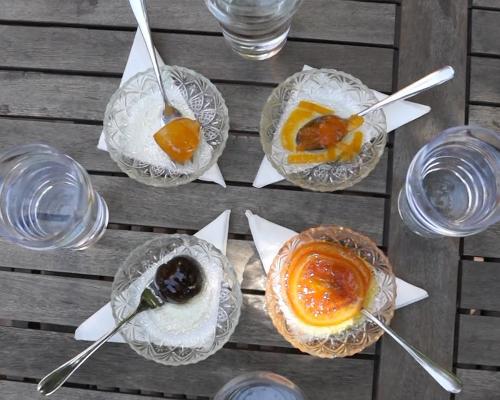
Household products (jams, spoon sweets)
Traditional jams and spoon sweets are an integral part of the gastronomic heritage of Ikaria. Beyond their enjoyment, these confections represent an old practice of preserving fruits and nuts, allowing residents to make use of seasonal abundance throughout the year. The variety is extensive and includes kaïsi (apricot), orange, cherry, bergamot, as well as the fragrant rose. Their production is based on family recipes that are passed down from generation to generation, with an emphasis on the quality of pure, local ingredients and the absence of preservatives.
Identification and Variations
The most characteristic flavors produced in Ikaria, making use of local production, include Cherry (considered to be of exceptional quality due to the microclimate), Bergamot (usually as a spoon sweet), Morello Cherry, Nerantzi Rolé (bitter orange roll), Fig, Strawberry, Apricot and various citrus fruits (lemon, orange), as well as more distinctive flavors such as Arbutus (from the fruit of the strawberry tree) and Blackberry. The name variations mainly concern the flavors and the form: “spoon sweet” for whole or large pieces of fruit in thick syrup, and “jam” for puréed or chopped fruit.
The production of traditional sweets and jams is directly linked to the rural hinterland of Ikaria, where the corresponding fruit trees and crops thrive. Characteristically, the area of Panagia in Agios Kirykos is mentioned as a center of traditional sweets production, which underscores the importance of the island’s small, mountainous and semi-mountainous cultivations.
The mild Mediterranean climate, with significant humidity in certain areas, and the varied relief of Ikaria, create an ideal microclimate for the development of fruits and nuts with distinctive aromas and flavors. The fresh fruits used come mainly from the island’s local crops, often from small orchards maintained with traditional, non‑intensive cultivation methods, contributing to the quality and distinctive taste of the final product.
The production method for spoon sweets and jams in Ikaria remains largely traditional and handmade, with recipes faithfully followed for decades.
The process begins with harvesting the fruit at the point of full ripeness, in order to ensure maximum flavor and aroma. The fruit, such as cherries, sour cherries, bergamot or figs, is processed immediately after harvesting, without being stored in refrigerators or preservatives. For spoon sweets, the fruit or parts of it (e.g., citrus peel) are cleaned, pierced (so the syrup can penetrate) or cut into pieces.
The central stage is boiling with sugar (and sometimes lemon juice to regulate pH and aid setting). Boiling is done slowly in a cauldron or large pot, with constant supervision and removal of the foam that forms, a detail that is crucial for the clarity and quality of the syrup. The amount of sugar is generally high, acting as a natural preservative. In spoon sweets, the aim is for the syrup to “set” to the right point, so that the fruit keeps its shape and remains crisp, while in jams the goal is for the pulped fruit to set into a thick gel. Producers emphasize that they use only pure ingredients, such as fresh fruit and sugar, and do not add preservatives, relying on the traditional boiling technique and on jar sterilization to preserve the product.
The production of traditional sweets and jams in Ikaria has a significant impact on the island’s economy and the preservation of its rural tradition. First, it strengthens the local agricultural economy by making use of seasonal fruits from small farms, providing income to family businesses and reducing dependence on imported raw materials. In addition, the sweets serve as recognizable tourist products and souvenirs, showcasing the richness of Ikarian nature and the traditional dietary practices associated with the Blue Zone and longevity. The preservation of traditional production methods ensures the transmission of this intangible cultural heritage to younger generations.
The tradition of spoon sweets in Ikaria stems from the historical need to preserve perishable fruits before refrigeration, using sugar as the main preservative, so that families could enjoy the fruits of summer throughout the winter. Production in Ikaria retains its family-based and handmade character, with recipes passed down unchanged from generation to generation, sometimes since the 1950s, and directly linked to the island’s rural way of life.
Spoon sweet is a central element of social and cultural heritage. It remains the typical hospitality treat in every Ikarian home, offered to the visitor on a small plate along with a glass of cold water. This tradition is an expression of the Ikarian philosophy of simplicity, abundance, and warm welcome.
Spoon sweets and jams are linked to festive customs and important moments of Ikarian life.
Traditionally, spoon sweet was the first treat offered at:
- Weddings: Symbolizing the sweet beginning of the new life, it was often prepared in large quantities from seasonal fruits.
- Baptisms: As a sweet welcome for the new member of the community.
- Name Days/Visits: Offering it was an inviolable rule of hospitality and constituted a sign of honor toward the guest.
Moreover, the preparation process itself was a social event (especially for sweets that required careful handling, such as bergamot peel). The women of the neighborhood often worked together, exchanging techniques and recipes, thereby strengthening the social bonds of the small community.