Mastelo
Mastelo is one of the most recognizable and popular dairy products of Chios which, in contrast to many traditional Greek cheeses, is a trademark and not a type of cheese or an official geographical indication. The name comes from the Venetian word mastelo, meaning the wooden tub that was traditionally used for collecting milk. The product became widely known thanks to the producer K. Toumazos, who has been making it since 1994, using high-quality fresh, whole cow’s and goat’s milk from Chios. Mastelo® is available in various forms (soft cow’s, goat’s, smoked, anthotyro and salty hard), with the soft cow’s cheese being the most sought-after, especially for its ability to be grilled without melting.
The name Mastelo has been a registered trademark since 1994, both in Greece and in Europe, for the products of this specific dairy unit on Chios. This means that the term does not refer to a type of cheese with specifications defined by the state, but to a specific commercial production based on local raw materials and techniques.
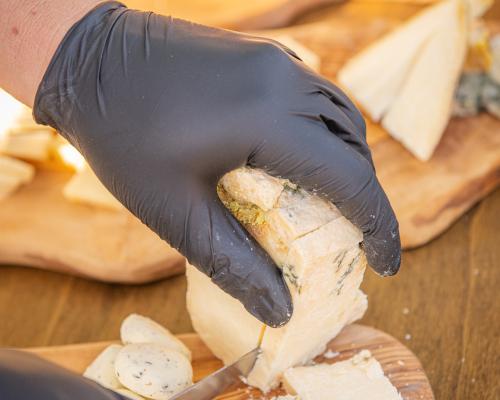
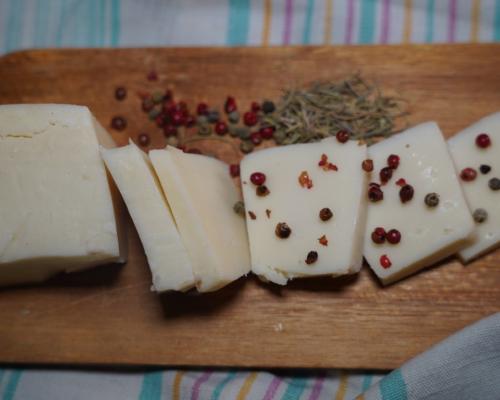
Officially, the cheese belongs to the category of soft white cheeses. The basic Mastelo is made from cow’s milk, is lightly salted and has a high moisture content. Its uniqueness lies in its special composition, which allows it to retain its shape and acquire a pleasantly chewy texture when cooked at high temperature, instead of melting like most cheeses. This characteristic has made it synonymous with grilled cheese, especially in the tavernas of Chios.
The production of Mastelo cheese is inextricably linked with the island of Chios, one of the largest and richest islands of the Eastern Aegean, known mainly for its mastic and citrus fruits. Its production takes place in Kambos of Chios, an area with particularly fertile soil and traditional farmhouses, which historically also hosted cattle farming, in contrast to many other Aegean islands where sheep and goat farming dominates.
The cow’s milk used for the production of the cheese comes from livestock units on Chios. The island’s particular soil and climatic conditions and its local flora (especially in the mountainous areas, for the goat’s milk) affect the animals’ diet and, consequently, the flavor profile of the milk, imparting to the final product the characteristics of the land of Chios. The Mastelo® production facility is located in Kambos of Chios, an area historically known for its agricultural tradition and fertile soils.
The production of cow’s milk Mastelo follows a relatively simple yet specific process that allows the cheese to develop its characteristic structure.
The process begins with the immediate use of fresh, whole, pasteurized cow’s milk collected from local farms on Chios. The milk is heated and then rennet (whey) and a small amount of salt are added. Coagulation of the milk takes place under mild conditions. The resulting curd is cut and stirred carefully to release the whey, but in a way that preserves the maximum possible moisture in the cheese.
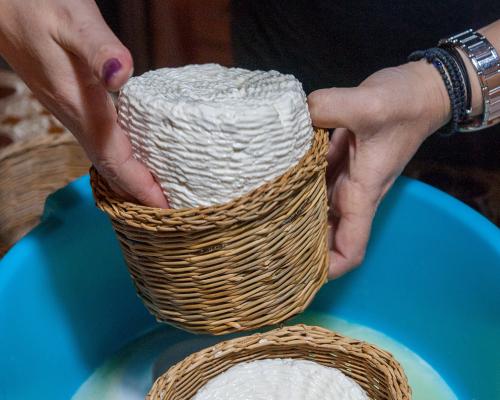
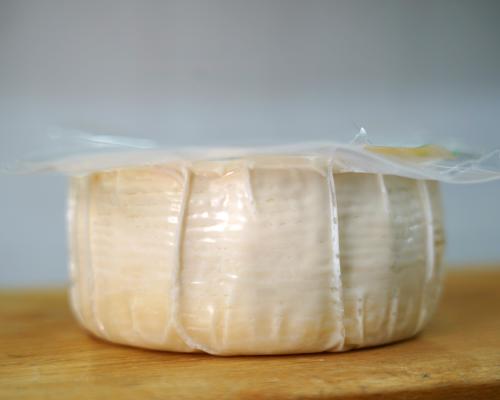
The curd is then transferred into molds to drain and take its final shape, usually cylindrical or a small wheel weighing about 350–400 grams. The maturation process is very short or practically nonexistent, since Mastelo is a cheese for immediate consumption that does not require long-term aging. It is stored in the refrigerator, usually in vacuum packaging, preserving its freshness and milky flavor. Emphasis is placed on minimal processing, allowing the quality of Chian milk to predominate.
The commercial success of Mastelo has a significant impact on the local economy of Chios. Since its production relies exclusively on Chian cow’s and goat’s milk, it directly supports the island’s cattle-farming sector, and to a lesser extent goat and sheep farming, which are crucial for biodiversity and self-sufficiency.
Its recognition as “Cheese of Chios” strengthens gastronomic tourism and the image of the island as a destination with quality local products. Grilled Mastelo has become a hallmark in local tavernas and restaurants, serving as an ambassador of Chian cuisine throughout Greece.
The history of Mastelo® as a commercial product is relatively recent, beginning in 1994. However, the name “Mastelo” has deeper roots, deriving from the Venetian word for the milk-collecting tub. This name alludes to the historical influence of the Genoese and Venetians on Chios, who for centuries shaped the island’s commercial and agricultural culture.
The production of the cheese is inextricably linked to the high quality of the local milk produced by animals grazing on the mountains and pastures of Chios, thus continuing the island’s traditional livestock-farming heritage despite the modern production method.
The dairy company that produces Mastelo has received awards and distinctions in national and international competitions for its products.
- 2019: Gourmet Award – Gold Award at the Greek Taste Awards, for Mastelo Cow’s Milk Cheese, in the Cheese–Cold Cuts category.
- 2016: Great Taste Awards – 1 Star for Mastelo Goat’s Cheese, in one of the most respected international taste competitions.
- 2016: Best Grilling Product Award at the International Food & Beverage Competition.
Goat Kid Mastelo is a lighter dietary choice with less fat (possibly <20%) and is often recommended for those following stricter diets. Both variations are rich in calcium and phosphorus, as well as vitamins A and B12.
Goat Kid Mastelo is a lighter dietary choice with less fat (possibly <20%) and is often recommended for those following stricter diets. Both variations are rich in calcium and phosphorus, as well as vitamins A and B12.