Mizithra Chios
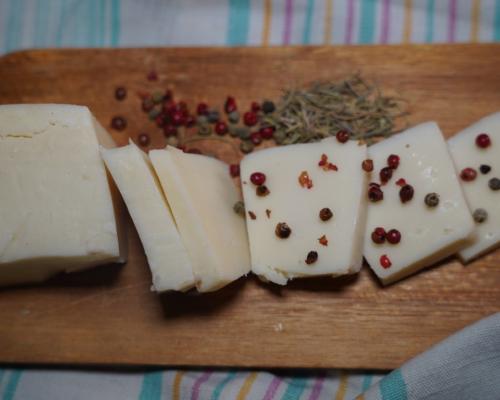
Mizithra is an age‑old, traditional Greek cheese that belongs to the category of whey cheeses. Its production is directly linked to the cheesemaking of other hard cheeses, as it consists of the curd formed from the whey proteins (albumins and globulins) that remain in the whey. On Chios, the production of Mizithra is an integral part of local livestock farming and cheesemaking. The Mizithra of Chios, like most Greek variants, is produced mainly from goat and sheep whey with the addition of fresh milk (prosgala) and can be consumed in two basic forms: fresh (chlorí) with a soft, creamy texture and sweet taste, or dry (hard) after salting and maturation, with an intense, piquant and salty flavor.
Identification and PDO/PGI Status
While Mizithra appears under various synonyms and name variants in Greece (e.g. Xinomizithra in Crete, Anari in Cyprus, Tsimiksia as a traditional mold), for Chios no specific local name is identified other than “Mizithra” in commercial contexts.
Specifications (General)
Since there are no official PDO/PGI specifications for Chios Mizithra, the specifications follow the general characteristics of Greek mizithra:
- Raw Material: Whey from goat and sheep milk (which on Chios may come from the short‑lived Chios sheep breed, known for the high quality of its milk, or from local goat breeds) with the addition of fresh goat and sheep prosgala.
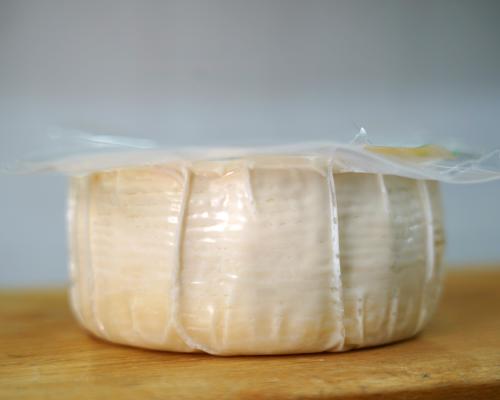
- Texture & Color: Fresh Mizithra has a soft, creamy texture, without rind, and a white to off‑white color. The dry type develops a hard, compact mass, an off‑white color, and is suitable for grating.
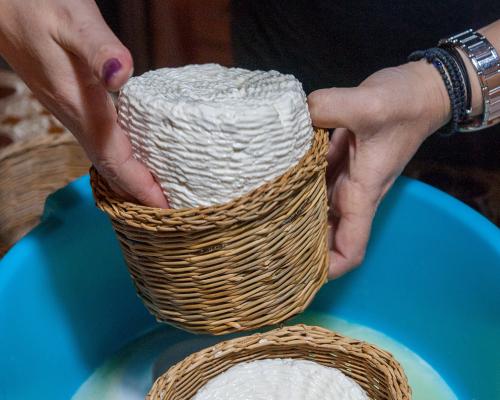
- Shape: Often pear‑shaped or a truncated cone due to traditional draining in special cloth bags (tsantiles) or in tsimiksia.
- Moisture:
- Fresh/Chlorí: Up to 70% by weight.
- Dry/Hard: Up to 40% by weight (for hard cheese).
- Fat content: At least 50% on dry matter, although fresh mizithra is considered relatively low in fat.
The production of Chios Mizithra is linked to the geographical area of the island of Chios. The insular geography and the local climatic conditions, such as the dry, hot summer period and the mild winters, shape the island’s flora. The diet of the local sheep and goats—which includes endemic herbs and wildflowers—directly affects the quality and aromatic profile of the milk and, consequently, of the whey.
The production of Chios Mizithra follows the traditional method of making whey cheeses, which is a secondary cheesemaking process, since the main ingredient comes from the production of other cheeses (e.g. local Kefalotyri or Chios Mastelo).
Traditional Production Method
- Collection and Heating of Whey: The process begins with the collection of the whey left over from the production of the main cheese. The whey is transferred to cheese vats and heated under constant stirring. The temperature rises gradually, with denaturation of the whey proteins beginning at about 62°C and peaking near 90°C.
- Addition of “Prosgalo”: At a temperature of about 70°C, “prosgalo” is added, that is, fresh whole (goat and sheep) milk at a ratio of about 10% of the whey. This addition improves the yield and texture of the final product. Heating continues at 85–90°C, where thermal denaturation of the proteins (albumin and globulins) is achieved, and they begin to rise to the surface, forming a mass.
- Acidity adjustment: In certain variations, to achieve the optimal pH (around 5.2 – the isoelectric point of β-lactoglobulin) that favors coagulation, lemon juice can traditionally be used instead of rennet, although the use of rennet is not excluded.
- Molding and Draining: The mass of curd that has risen to the surface is carefully collected with a slotted spoon. For the production of fresh (soft) Mizithra, the curd is placed in special molds or cloth bags and left to drain for about 12 to 24 hours.
- Maturation (for Dry Myzithra): If the production of dry (hard) Myzithra is desired, the fresh cheese is salted externally with coarse salt and left to mature and dry in a ventilated area. After drying, Chios hard Myzithra acquires an intensely salty and piquant flavor.
The production of Mizithra in Chios constitutes an important pillar of the circular economy in the island’s primary sector. It functions as a product that utilizes a by-product (whey) which would otherwise pose an environmental problem, thus contributing to the sustainability of local cheese-making units. At the same time, the existence of a traditional cheese, in addition to the main products such as Mastelo, enriches local gastronomy and preserves the livestock-farming tradition and cheese-making techniques that are passed down from generation to generation. Finally, Chios Mizithra, though less well known, supports the local market and supplies households and visitors with a fresh, nutritious dairy product.
Mizithra is a cheese with a history that vanishes into the depths of the centuries in Greece, with references pointing back to antiquity, when the use of whey for cheese production was a widely practiced technique. In Chios, its production is inextricably linked to the cheese-making cycle of hard cheeses. Mizithra, as a simple, basic, and quickly produced cheese, has always been the everyday source of protein for livestock farmers and their families, while its dry form allowed the preservation of the dairy product throughout the year. This timeless connection with rural life makes Mizithra a cultural legacy of the island.
Mizithra in Chios, as in many islands of the Aegean, is a basic ingredient in local customs and celebrations, mainly through the cheese pies and sweets prepared with its fresh, sweet form. Traditionally, the production of Mizithra was more intense in spring, when the goat and sheep milk was richer and cheesemaking in full swing. The production of fresh Mizithra, which must be consumed immediately, was often associated with family gatherings or exchanges of goods in the villages, as it constituted a quick “gift” of the cheesemaking process, a token of the abundance of the season.
Myzithra is generally considered a cheese of high nutritional value, especially in its fresh form, as it is rich in whey proteins (albumins), which are regarded as having higher biological value compared to casein proteins. In addition, fresh Myzithra has a comparatively low fat and salt content relative to hard cheeses, making it a “light” choice.
Although there are no specific data for Chios Myzithra, a typical nutritional analysis per 100 g for fresh (soft) and dry (hard) Myzithra is as follows:
- Fresh/Green Myzithra (Approximate values per 100 g of edible portion):
- Energy: ≈228 kcal
- Proteins: ≈15–18 g (High content)
- Fats: ≈18–20 g
- Carbohydrates: ≈2–5 g (Lactose)
- Sodium/Salt: Low content (< 1 g), ideal for low-salt diets.
- Dry/Hard Myzithra (Approximate values per 100 g of edible portion):
- Energy: ≈275 kcal
- Proteins: ≈21 g (High content due to moisture loss)
- Fats: ≈17 g
- Sugars: ≈5 g
- Salt: High content (>2 g), due to the addition of salt for maturation.
Mizithra is also a source of calcium and phosphorus, although soft whey cheeses tend to have a lower calcium content compared to hard cheeses, since most of the calcium is removed with the whey during the production of the original cheese.
Myzithra is generally considered a cheese of high nutritional value, especially in its fresh form, as it is rich in whey proteins (albumins), which are regarded as having higher biological value compared to casein proteins. In addition, fresh Myzithra has a comparatively low fat and salt content relative to hard cheeses, making it a “light” choice.
Although there are no specific data for Chios Myzithra, a typical nutritional analysis per 100 g for fresh (soft) and dry (hard) Myzithra is as follows:
- Fresh/Green Myzithra (Approximate values per 100 g of edible portion):
- Energy: ≈228 kcal
- Proteins: ≈15–18 g (High content)
- Fats: ≈18–20 g
- Carbohydrates: ≈2–5 g (Lactose)
- Sodium/Salt: Low content (< 1 g), ideal for low-salt diets.
- Dry/Hard Myzithra (Approximate values per 100 g of edible portion):
- Energy: ≈275 kcal
- Proteins: ≈21 g (High content due to moisture loss)
- Fats: ≈17 g
- Sugars: ≈5 g
- Salt: High content (>2 g), due to the addition of salt for maturation.
Mizithra is also a source of calcium and phosphorus, although soft whey cheeses tend to have a lower calcium content compared to hard cheeses, since most of the calcium is removed with the whey during the production of the original cheese.