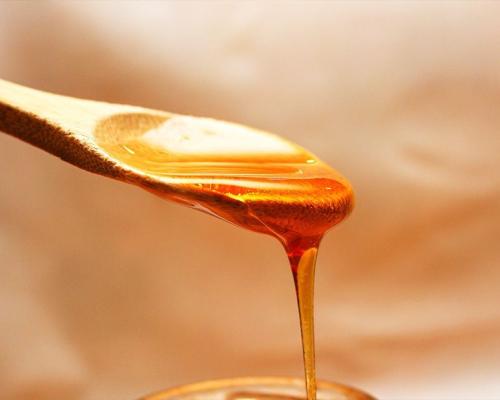
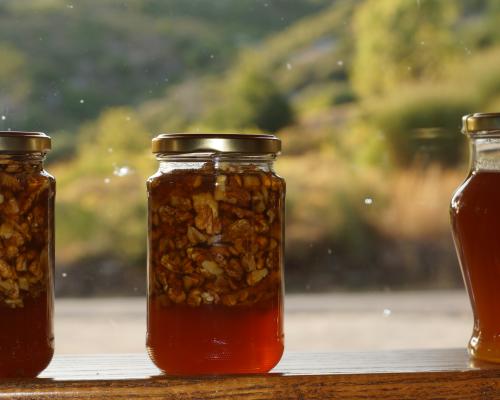
Oinousses Honey
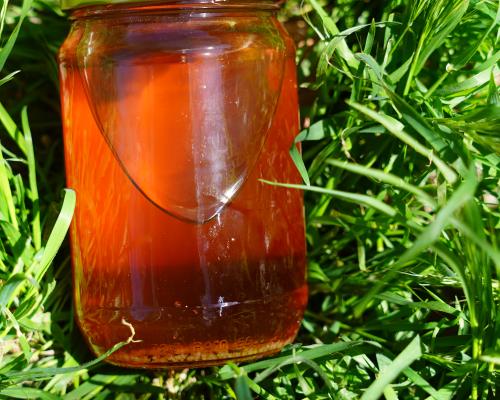
Oinousses Honey is a characteristic product of the local agricultural production of the small island complex of Oinousses, located northeast of Chios, in the Aegean. Beekeeping on the island, although small in scale, makes use of the area’s distinctive arid and uncultivated flora, which is dominated by aromatic plants. The honey produced in Oinousses is primarily thyme honey, a fact that places it among the most select categories of Greek honey, renowned for its intense aroma and high quality. Production contributes to the preservation of traditional economic activity, alongside shipping, which constitutes the island’s main pillar.
The honey of Oinousses is identified primarily as Thyme Honey, due to the dominance of thyme (most likely the species Corydothymus capitatus) in the island’s vegetation.
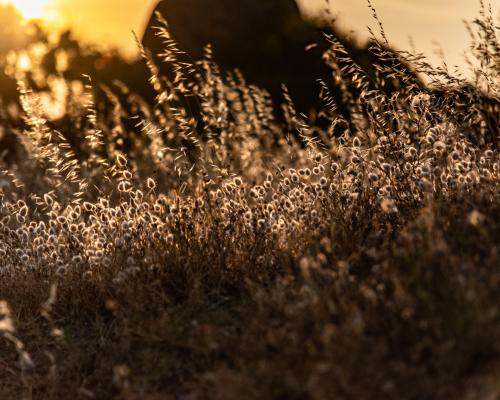
Oinousses is a small island complex of the Northern Aegean, with the main island being Oinousses (or Egnousa). The island is characterized by sparse and low vegetation, typical of arid island ecosystems. The soil is mainly rocky and dry, a condition that favors the growth of aromatic plants and shrubs.
The beekeeping flora of the island is relatively limited in variety, but of exceptional quality. The dominant source of nectar is thyme (Thymbra capitata), whose flowering, depending on climatic conditions, constitutes the main summer nectar flow (late May to mid-June), imparting to the honey its unique organoleptic characteristics. The absence of intensive agricultural crops and the relatively isolated location of the island contribute to the preservation of a clean environment, free from the use of pesticides, a factor that enhances the purity and quality of the honey produced.
Beekeeping in Oinousses maintains a traditional character, adapted to the limited, thyme-dominated flora. The main production focuses on exploiting the summer flowering of thyme.
The harvesting is carried out by transporting the hives to areas of intensive flowering, as soon as the honey in the combs has matured and been sealed (moisture $<20\%$). Production is governed by the principle of minimal processing. After uncapping, the honey is extracted by centrifugation at low temperatures. This is followed by slow filtration to remove the wax and then standardization. An essential good practice is the avoidance of excessive heating, ensuring the preservation of the bioactive components and the aroma of thyme honey. Due to the high stress placed on the colonies by the intense nectar flow, emphasis is placed on the continuous renewal of the population and the adequate provision of pollen.
Honey production in Oinousses, although small in scale, has a significant socio-economic and environmental impact on the island. First and foremost, it constitutes one of the few traditional primary productive activities, offering residents a source of income beyond shipping, which dominates the economy. The preservation of beekeeping contributes to the diversification of the economy and to the island’s self-sufficiency.
Environmentally, bees are vital for the pollination of the local flora, especially aromatic plants such as thyme, thus helping to maintain the biodiversity of the arid island ecosystem. Finally, Oinousses Honey serves as a high-quality local product, which reinforces the identity and image of the island as a destination with pure, traditional products, adding gastronomic value.
Beekeeping in the Aegean islands has historical roots that go back to antiquity, since honey was a basic sweetening substance. In Oinousses, as in many small islands, this practice is closely linked to the agricultural tradition that developed in parallel with its maritime history. While the island is known mainly for its shipowners, beekeeping was maintained as a secondary yet essential activity to secure food and to make use of the limited natural vegetation.
Thyme honey, as the predominant type, is inextricably linked to the culture of shrubland and the hot, dry land of the North Aegean. Its production, though modest, is part of the heritage of survival and self-sufficiency of islanders who had to make use of every resource their land could offer.