Sour trahana
Sour trahana of Samos is a characteristic traditional pasta of the island, belonging to the broader category of Greek pasta made on the basis of cereals and dairy products. Its particularity lies in the use of sour milk or yogurt, instead of the fresh milk used in sweet trahana, giving it a distinctive, slightly tangy taste. In Samos, as well as in other regions, its production is closely linked to the use of surplus milk during the summer months, constituting a traditional method of preserving it and resulting in a product of high nutritional value, ideal for dietary needs, especially during the winter.
Sour Trahana of Samos, also known as coarse trahana, stands out for the combination of its ingredients, which usually include wheat or semolina, as well as fresh Greek milk that is soured, often a mixture of goat’s and cow’s milk (for example, in a 50%-50% ratio in local preparations in Mytilinioi of Samos). This combination of milks, originating from local livestock farming, gives the trahana of Samos a distinctive aroma and flavor, setting it apart from other mainland or island variants.
Trahana of Samos is a traditional locally produced product that bears the indication of the area due to its historical recipe and the use of local raw materials.
The production of traditional sour trahana in Samos is found mainly in the mountainous and semi-mountainous villages of the island, where livestock farming has always been an important part of the agricultural economy. Trahana is closely associated with rural communities, such as Mytilinioi, where there are references to local preparations. The geographical location of the island in the North Aegean, with its dry, warm climate and abundant sunshine during the summer months, is of vital importance for the production process. Specifically, trahana is traditionally produced in the summer, as the strong sun and dry atmosphere are necessary for the proper and rapid drying and dehydration of the dough, thus ensuring its long-term preservation.
The production of Samos sour trahana follows an age‑old traditional method aimed at preserving foodstuffs, mainly milk. The process begins with souring the milk, which may be goat’s or cow’s milk, or a combination of the two. The souring is achieved either by allowing the milk to sour naturally (fermentation) or by adding yogurt, resulting in the creation of an acidic environment.
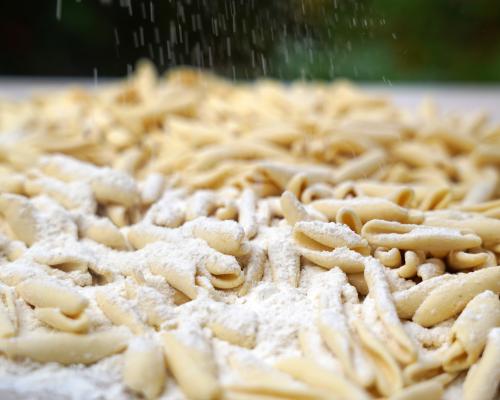
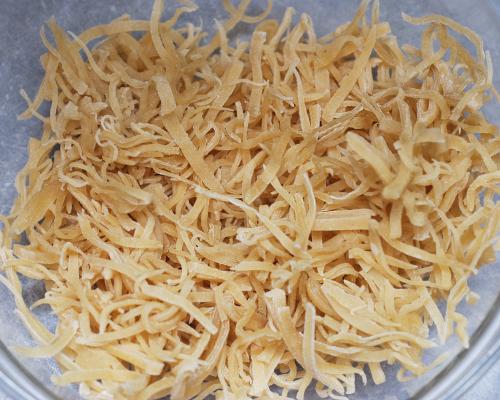
Next, the soured dairy product is mixed with cracked wheat or flour or semolina and kneaded well until a firm dough is formed. This dough is traditionally rubbed by hand over a sieve or perforated surface to create the characteristic, irregular grains of trahana. Alternatively, the dough can be rolled out into thin sheets, partially dried, and then grated in a food processor or mill to acquire its familiar granular form. The final and decisive stage is the drying of the grains, which is done by spreading them out on clean cloths or tablecloths in the sun for two to three days, until they are completely dehydrated and ready for storage, usually in airtight containers or tin boxes.
Sour trahanas symbolizes self-sufficiency and the utilization of Samos’ local resources. Its production has historically contributed to the preservation of small-scale livestock farming on the island, as it offered an intelligent and sustainable way to preserve surplus milk. Moreover, trahanas, being a product that relies mainly on human labor, preserves traditional know-how within farming families and serves as a source of small-scale economic activity through local workshops and cooperatives. Its promotion as a traditional Samian product strengthens the island’s cultural identity and its gastronomic tourism, offering visitors an authentic taste of the local dietary heritage.
Trahanas, in the broader sense of a dried mixture of grains and milk, has origins that are lost in the depths of the centuries, with references dating back to the 1st century AD, when Apicius mentions a thick porridge called “tractae.” The word “trahanas” is thought to derive from the Persian “tarkhaneh” or from the Greek words “trachys” (rough) and “traganos” (crisp). On the islands, such as Samos, its production was a social event, as it was made collectively by the women of the village, mainly in August, in order to take advantage of the scorching sun for drying. Trahanas was the basic survival food for the poor, shepherds and seamen, as it was easy to transport, kept for a long time and provided significant energy at low cost. In Samos, sour trahanas, in contrast to the sweet variety that dominates in other islands, stands as evidence of the inhabitants’ survival and ingenuity.
Trachanas is inextricably linked with rural traditions and winter nutrition. Its preparation, known as “trachanókopsimo,” was a custom that marked the end of summer abundance and the preparation for winter. Women would gather in courtyards, rub the dough, and spread the grains out on large sheets under the strong sun. This collective work turned into a celebration with songs, conversation, and food. In Samos, trachanas soup was traditionally served as a fortifying food to the sick, children, and pregnant women, while it was the ideal choice for a quick, nourishing, and warming dish on cold nights.