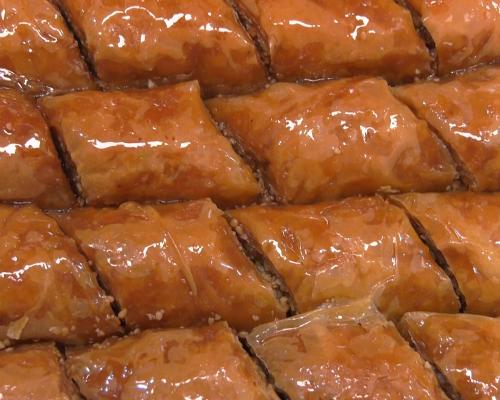
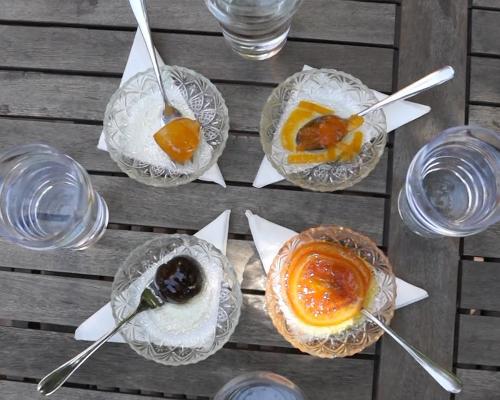
Tray sweets
Tray sweets in Lesvos are an integral part of the local gastronomic tradition, usually associated with festivals, customs and family gatherings. They are characterized by the use of local farm products, with Lesvos olive oil taking pride of place, as well as ouzo, nuts (especially walnuts) and honey or sugar for the syrup. These confections are deeply rooted in the island’s social life, serving as the crowning touch of every formal meal and important occasion, such as Christmas, when Platsenta is traditionally prepared. Lesvos, as an island with rich agricultural production and strong ties to Asia Minor, has adopted and preserved recipes that reflect this cultural wealth.
The most recognizable traditional tray sweet of Lesvos is Platsenta. It is often referred to as the island’s “Christmas pie.” Other tray sweets that enjoy local recognition, though not mentioned as frequently, include the distinctive Vasilopita of Agiasos (which is a syrupy pie with a sweet-and-savory filling). The name Platsenta probably derives from the Latin word placenta (or the ancient Greek πλακοῦς), meaning flat pie or cake, indicating the long history of these preparations.
Tray sweets are prepared throughout Lesvos; however, specific variations are closely linked to particular areas. Platsenta is widespread in Mytilene and across the entire island as a Christmas delicacy. Vasilopita, with its distinctive spices and sweet-and-savory filling, is a traditional custom of the mountain village of Agiasos. The geographical expanse of Lesvos, with its rich agricultural production of olives, oil, ouzo and honey, provides abundant raw materials. The island is characterized by varied terrain and microclimates, with the western side being drier and the eastern more fertile. This fertility, combined with dense olive cultivation, boosts the production of the key ingredient, olive oil, which is used not only for brushing the pastry sheets but often also in the dough of traditional tray sweets, giving them a characteristic texture and aroma.
Production Method of Platsenta (Traditional Tray Sweet)
The production of traditional Platsenta is based on a time-consuming, handmade process that requires skill in rolling out the pastry sheets.
- Dough Preparation (Phyllo): The dough is traditionally made with flour, water, salt, olive oil and, most characteristically, ouzo. The addition of ouzo not only provides aroma, but also contributes to the development and rolling out of the thin sheets, as well as to their final crispness.
- Rolling Out the Phyllo: The dough is divided into small balls, which are rolled out with a rolling pin (rod) into extremely thin round sheets. Cornflour or flour is often used during rolling.
- Filling: The filling consists mainly of coarsely chopped walnuts (locally produced where possible), mixed with cinnamon and clove.
- Assembly: The sheets are spread out in the baking pan (traditionally round), brushed with olive oil (and/or butter) and sprinkled with the filling. They can be rolled up, crinkled, or laid flat, creating layers.
- Baking: The sweet is baked at a moderate temperature until golden brown and crisp.
- Syruping: The hot sweet is drenched with cold syrup. The syrup is made with sugar, water, lemon juice and, often, honey is added at the end, after it is removed from the heat, in order to preserve its aromas and impart sweetness and shine. The use of syrup allows the sweet to become honeyed and more compact after one or two days.
The traditional tools include the wooden rolling pin (rod) for rolling out the sheets and the large copper or iron pans for baking.
Tray-baked sweets, and in particular Platsenta, have a significant socioeconomic and touristic impact on Lesvos.
- Economy & Local Production: Their production strengthens the local market, as key ingredients such as Lesvos/Mytilene PGI olive oil, ouzo, honey and nuts (walnuts) are used. The island’s small cottage industries and women’s cooperatives often prepare and sell these traditional sweets, contributing to the preservation of the rural economy and traditional techniques.
- Tourism: Traditional sweets are a gastronomic attraction. Along with ouzo and olive oil, Platsenta and the Agiasos Vasilopita promote the gastronomic identity of Lesvos, placing it on the map of gastro-tourism. The connection of the sweet with customs (e.g., Christmas) creates an authentic experience for visitors.
The history of tray-baked sweets in Lesvos is closely linked to the Eastern Mediterranean and Asia Minor influences. The type of syrupy sweet made with thin filo pastry, nuts, and spices points to Byzantine and Ottoman gastronomic roots. The very word “Platsenta” suggests an ancient origin, connecting it with the ancient Greek and Roman tradition of the flat pie.
The cultural heritage of tray-baked sweets is expressed through the preparation process. It is a process that was traditionally carried out collectively by the women of the family or the neighborhood, especially before major festivities. The recipe was passed down orally from generation to generation, ensuring the preservation of traditional techniques, such as hand-rolling the filo. Ouzo, a product inextricably linked with Lesvos, was incorporated into the dough of the sweets, reinforcing the local identity of the delicacy and the uniqueness of the recipe.
Tray-baked sweets in Lesvos follow customs and seasons.
- Platsenta and Christmas: Platsenta is the quintessential Christmas sweet of Lesvos. Its preparation marks the beginning of the festive season, with the aroma of cinnamon and cloves filling the homes. It is the sweet offered to visitors and guests during the Christmas days, symbolizing the sweetness and abundance of the new year.
- Vasilopita of Agiasos: In Agiasos, the traditional Vasilopita, which is a syrupy tray-baked pie (baklava-type), has the unique custom of being prepared with both sweet and savory filling (cheeses and spices), although the sweet version predominates. It is offered on New Year’s Day during the custom of cutting the Vasilopita, where the lucky person who finds the coin wins the blessing and good fortune of the year.