tsikouda (passatempo)
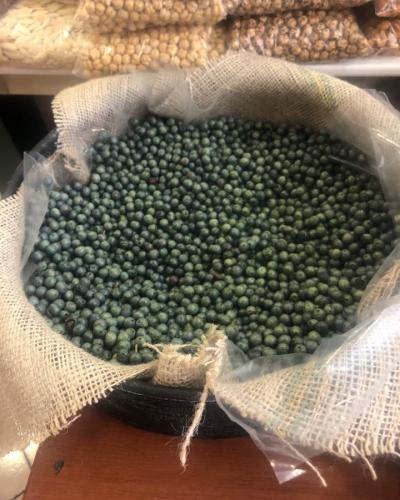
In Chios, tsikouda (also known as “Chian passatempo”) are the spicy, aromatic fruit of the tsikoudia tree (or Kokkorevythia), whose scientific name is Pistacia terebinthus (Terebinth). It belongs to the Anacardiaceae family, being a close relative of the Aegina pistachio (Pistacia vera) and the mastic-bearing lentisk (Pistacia lentiscus). This nut has deep roots in local tradition, having been used historically not only as a direct snack, but also for the production of a rare oil.
Tsikouda are the fruit of the tsikoudia tree (Pistacia terebinthus), a tree that thrives in the Mediterranean region. In Chios, it is considered a characteristic autumn snack, a local “passatempo” with a distinctive, spicy flavor. The people of Chios usually consume the outer skin of the fruit, spitting out the hard kernel, although there are variations such as the thick “rovithata” and the “chantziminata” tsikouda. Of particular importance is the historical use of the fruit for the production of Tsikoudolado (or Terebinth Oil), a rare seed oil with high nutritional value and zero acidity, which was formerly used in confectionery as well.
The tsikoudia (Pistacia terebinthus) is a plant of Mediterranean origin, found widely from Spain to Lebanon. In Chios, the tree thrives in various parts of the island, where it is often found in the wild or cultivated. The island’s soil and climate conditions, characterized by a Mediterranean climate with mild winters and dry, hot summers, are particularly favorable for the genus Pistacia, to which the famous Chios mastic (Pistacia lentiscus) also belongs. The presence of the plant in Chios is so significant that the global scientific name of the genus (Pistacia) has been historically associated with the name of the island (e.g., Chian turpentine).
The tsikoudia is a hardy tree that does not require intensive cultivation, yet its traditional use in Chios is more closely linked to the collection and utilization of its fruit and resin.
Harvesting and Fruit
Tsikouda are usually harvested in the autumn, when they ripen and acquire their characteristic aroma and flavor. In their traditional form, tsikouda are consumed as nuts, either fresh or dried. Consumption involves chewing the outer skin to extract the spicy juice and then discarding the hard kernel.
Traditional Processing (Tsikoudolado)
The main historical processing of the fruit was the production of Tsikoudolado. The process involved collecting the fruits and pressing them for oil, with the aim of extracting an exceptional seed oil. This tradition has almost disappeared today, as harvesting and oil extraction are considered economically unviable, leading to the gradual neglect of this practice.
By-products and other uses
The main purpose of cultivating the turpentine tree in Chios, beyond the fruit, was the production of krementina, a resin similar to pine resin, from which, after processing (boiling), Turpentine is produced (the well-known turpentine, also known as Chian or Scio turpentine). This resin has industrial uses (varnishes, oil paints). Other traditional uses include:
- Aromatic: Karposkino (seeds of another related plant, the mastic tree, mentioned together with the tsikouda) was used to flavor pickles and olives.
- Pharmaceutical: Historically, krementina has been used to produce oil for polishing leather due to its tannins, while the anti-inflammatory actions of its components have also been investigated. In Turkey, the fruits are used to produce green soap and a type of aromatic coffee.
Tsikoudia and its fruit, the tsikouda, are part of the rural and cultural landscape of Chios, albeit to a lesser extent than mastic. The presence of the tsikoudia contributes to the island’s biodiversity, while its historical exploitation for the production of Tsikoudolado and Turpentine linked the plant to the traditional economy and artisanal activities (e.g., soap-making, confectionery, leather processing). Today, the impact is mainly cultural and gastronomic, preserving a local snack tradition, especially during the autumn period.
Tsikoudia, as Pistacia terebinthus, has deep roots in the history of the Mediterranean and of Chios. Its close kinship with the pistachio and with the mastic-bearing lentisk makes it part of the broader Pistacia family that has shaped the agricultural identity of Chios. Historically, the tree was so widespread on the island that there were huge tsikoudia trees, which were carefully tended for the harvest of their fruit. The main historical role of tsikoudia in Chios was not the production of its fruit as a dry food, but the extraction of krementina (resin), which yielded the highest-quality Turpentine, internationally known as “Scio turpentine” (Chios turpentine). This use testifies to the importance of the tree not only as food, but also as a raw material for trade and craft industries.
Tsikouda on Chios are associated mainly with autumn, the season of their harvest, and with the social habit of eating them as a pastime snack. They are a favorite snack of the people of Chios, whom one can see chewing them in a particular way, removing the skin and spitting out the hard kernel. There is even a tradition of gathering different kinds of tsikouda, such as the “rovithata” and the “chantziminata.” Knowledge of how to consume them, namely cracking the hard kernel, is passed down from generation to generation, constituting a characteristic local custom that highlights the inhabitants’ special relationship with the nature of the island.
The nutritional value of the fruit (Tsikoudo) requires further scientific research; however, its traditional use and its composition, especially as a source of oil, suggest high nutritional value.
- Tsikoudolado (Extracted Oil): The oil that the people of Chios produced from tsikouda is described as an exceptional seed oil with zero acidity and rich flavor, which indicates high quality of fatty acids.
- Bioactive Compounds: All parts of the turpentine tree have a strong resinous smell, indicating the presence of terpenes and resins. The krementina resin contains large amounts of Tannin.
The nutritional value of the fruit (Tsikoudo) requires further scientific research; however, its traditional use and its composition, especially as a source of oil, suggest high nutritional value.
- Tsikoudolado (Extracted Oil): The oil that the people of Chios produced from tsikouda is described as an exceptional seed oil with zero acidity and rich flavor, which indicates high quality of fatty acids.
- Bioactive Compounds: All parts of the turpentine tree have a strong resinous smell, indicating the presence of terpenes and resins. The krementina resin contains large amounts of Tannin.