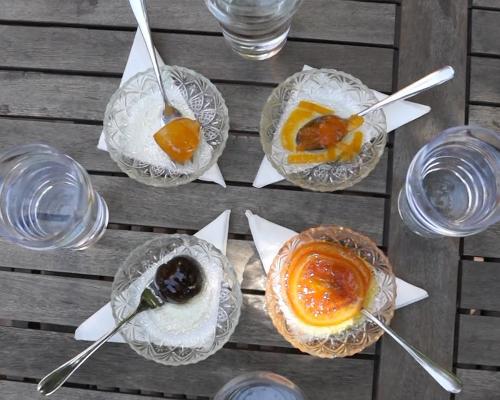
Jams and spoon sweets
Jams and spoon sweets are an important expression of the traditional gastronomy of Fourni Korseon (or simply Fourni). Their production is based primarily on the utilization of the citrus trees that thrive on the islands, providing the raw material for a wide range of sweets. These preparations, traditionally made at home on a small scale, in addition to covering household needs, have now become a local product promoted to visitors, contributing to the showcasing of the island’s agricultural production. Their homemade origin and the use of local, fresh fruits such as fig, orange, lemon, and quince lend them a distinctive character and quality.
The island’s citrus trees provide the raw material for the creation of a range of spoon sweets, while tradition dictates that they be produced with care, keeping whole pieces of fruit in the syrup, a technique that highlights the texture and intense flavor of the fruit.
In particular, some of the most popular types of sweets produced in the area include orange spoon sweet, lemon (usually from the peel), fig, and young green walnut, when it is in its early stage. The absence of industrial production ensures that the final taste and texture are as close as possible to the authentic homemade recipes of the older generations of Fourni.
The climate of the area, typical of the North Aegean, with mild winters and hot, dry summers, favors the growth of aromatic plants and the proper ripening of fruits. This local raw material, which does not require mass transportation, helps maintain its freshness and aromatic properties, which are then transferred to the final spoon sweet or jam.
The production of traditional spoon sweets and jams in Fourni Korseon follows the old, household technique, which ensures the preservation of the fruits and their rich flavor.
Process for Spoon Sweets:
- Selection and Preparation of Fruit (Seasonality): Fruits such as figs (harvested in summer), oranges (harvested in winter/spring), or unripe walnuts (harvested in early summer) are chosen when they are at the best possible stage of ripeness or, in the case of unripe fruit (e.g. green walnuts), at the appropriate moment for processing. This is followed by cleaning, cutting into pieces (or keeping the whole fruit), and often a liming process (soaking in limewater) to firm up the peel or the fruit, so that it retains its shape during boiling.
- Boiling and Syruping: The fruit is first boiled only with water in order to soften it and remove any possible bitter substances (especially in citrus fruits). Then sugar is added and the mixture is boiled again over low heat. The amount of sugar is traditionally high, ensuring the preservation of the product.
- Setting the Syrup: At the final stage of boiling, the housewife checks the “setting” of the syrup so that it is thick but not crystallized. Shortly before the end, lemon juice (from local lemons) is added to prevent the sugar from crystallizing and to balance the sweetness.
- Flavoring and Packaging: Aromatic leaves such as rose geranium or vanilla are often added for extra fragrance. The sweet is left to cool and is then standardized/packaged in sterilized glass jars.
Process for Marmalades:
Marmalades follow a similar process but usually involve pulping the fruit (or using chopped fruits) and boiling with sugar until they thicken. Citrus marmalades are particularly widespread, making use of their abundance.
The production of Jams and Spoon Sweets in Fournoi Korseon has a significant cultural and economic impact, albeit on a small scale.
- Utilization of Primary Production: Their preparation allows for full utilization of local fruits, especially citrus, reducing waste and turning them into long-lasting products.
- Tourism Development and Promotion: The homemade sweets are sold in local shops, such as “Melanthi” (where the availability of traditional local products is mentioned), and are offered as a treat in traditional guesthouses, such as “Archontiko tis Kyra Kokonas”, serving as a gastronomic identity of the island and as a keepsake for visitors.
- Preservation of Tradition: The continuation of this practice keeps alive the art of homemade confectionery and the knowledge of traditional food preservation techniques, which forms part of the cultural heritage of Fournoi.
The tradition of spoon sweets is deeply rooted in Greek, and by extension Aegean, cuisine, as the quintessential method of preserving fruit before the widespread adoption of freezing. In Fournoi, where agricultural production has always been limited, making use of every piece of fruit was vital. The production of sweets from citrus fruit and figs bears witness to the historical cultivation of these crops on the island.
The spoon sweet in Fournoi is not merely a dessert, but forms part of the island’s hospitality and social ritual. Traditionally, it was the treat offered to a visitor together with a glass of cold water, a symbol of courtesy and welcome, a practice that to a large extent is still maintained today.
The nutritional value of Spoon Sweets and Marmalades is determined mainly by their sugar content (carbohydrates) and the nutrients of the original fruit. Although the boiling process reduces the concentration of certain heat-sensitive vitamins (such as vitamin C), the sweets retain a significant portion of the fruit’s dietary fiber and minerals.
Figs, which are a basic raw material, are known for their high content of Potassium (which helps regulate blood pressure), Calcium and Iron, as well as B-complex Vitamins. A portion of these minerals and of the dietary fibers is preserved in the final sweet, making it, despite its high sugar content, a product that also carries benefits from the original fruit, in contrast to other simple confections.
The nutritional value of Spoon Sweets and Marmalades is determined mainly by their sugar content (carbohydrates) and the nutrients of the original fruit. Although the boiling process reduces the concentration of certain heat-sensitive vitamins (such as vitamin C), the sweets retain a significant portion of the fruit’s dietary fiber and minerals.
Figs, which are a basic raw material, are known for their high content of Potassium (which helps regulate blood pressure), Calcium and Iron, as well as B-complex Vitamins. A portion of these minerals and of the dietary fibers is preserved in the final sweet, making it, despite its high sugar content, a product that also carries benefits from the original fruit, in contrast to other simple confections.